Buying guide · Power tools
Drill, Impact Driver, or Impact Wrench: Which Job Is in Front of You?
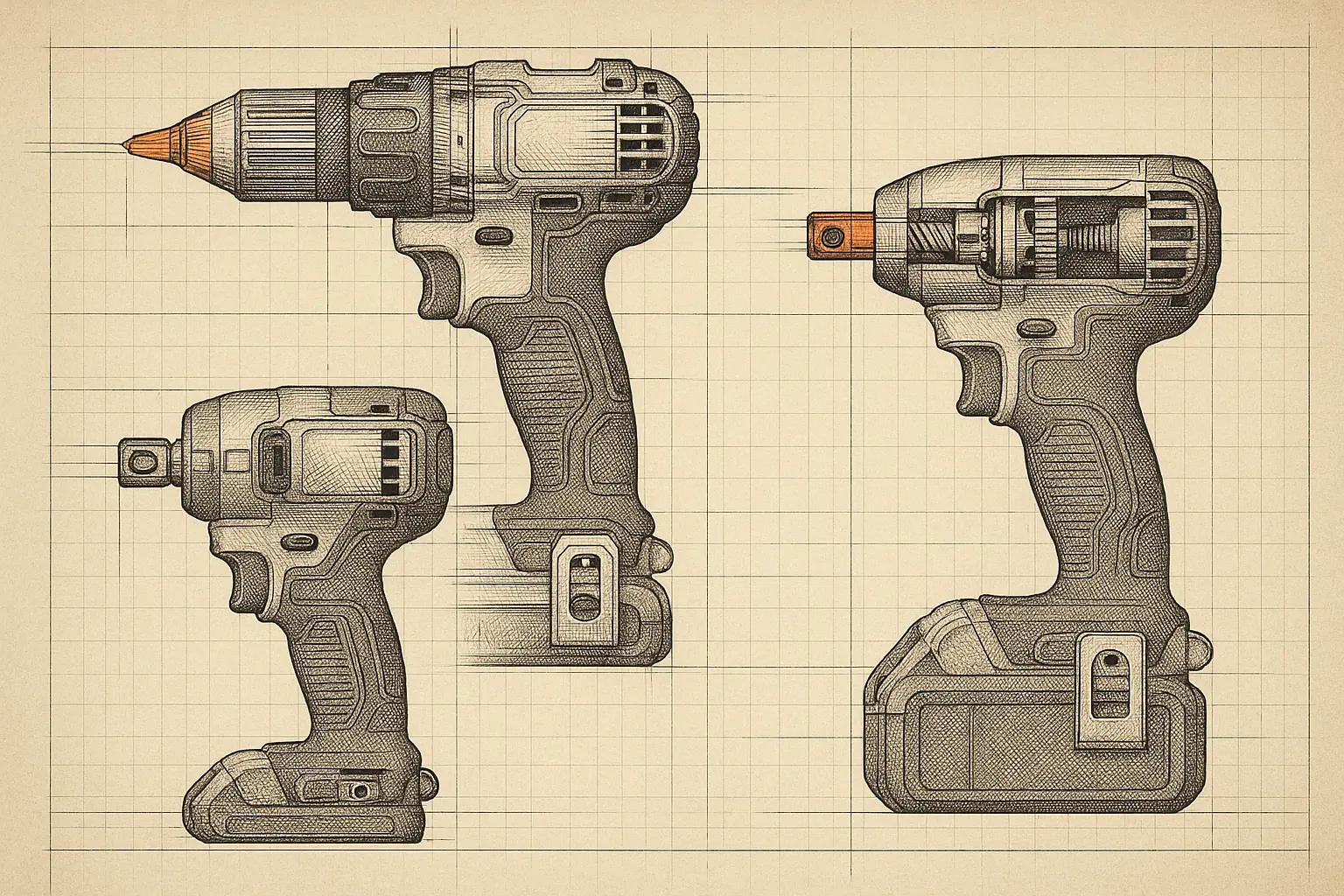
Saturday has three jobs on it. A closet shelf needs four clean pilot holes in a plaster wall and screws driven gently enough not to strip the anchors. The sagging gate needs a dozen 3-inch deck screws sunk to the head in dry cedar. And the winter tires are still on the car, a season late, behind lug nuts an impact gun at a shop tightened who-knows-how-hard. Three jobs, three fastening tools with confusingly similar names — and torque numbers on the boxes that look comparable and are not.
This guide is an audit, not a diary. As explained in How We Source, we don't run a test lab, and we won't pretend to: every figure below traces to a manufacturer document, a published safety standard, or a named, dated publication, and each claim carries a numbered marker keyed to the Sources Ledger at the foot of the page.
The decision, up front #
There is no "best" among these three, because they are not three grades of the same tool — they are three different mechanisms aimed at three different fasteners. The fork is: what is the fastener, and does it have a torque spec? Holes and precision screws want a drill. Long screws and lags into wood want an impact driver. Nuts and bolts with a number printed in a service manual want an impact wrench to break them loose — and a hand torque wrench to finish them. By reader type, downsides stated:
- First-house DIYer: a drill/driver first. It makes holes, and its clutch lets delicate screws survive you. Downside: long structural screws will push it to its limit — that is exactly where independent testing finds the impact driver pulling ahead[4].
- Apprentice or small contractor: the drill-plus-impact-driver two-piece kit is the standard answer, and for good reason: the driver handles the screw list, the drill handles the holes. Pro Tool Reviews' buying advice for construction trades is an 18V/20V-max impact driver as the first purchase[6]. Downside: two tools means the battery-platform decision comes first — that fork has its own audit.
- Home mechanic: the impact wrench is the one that actually moves lug nuts and suspension bolts; Pro Tool Reviews' line for automotive work is that a mid-torque model with "at least 400 ft-lbs of torque can accomplish most everything a mechanic needs"[6]. Downside: it is a loosening and running tool, not a finishing tool — the torque spec still belongs to a hand torque wrench (the final-torque rule).
- Renter with one budget slot: honestly, a drill/driver alone covers shelf, curtain rod and flat-pack life. Downside: the day a deck rebuild arrives, the drill will stall where a driver hammers through — plan to add, not replace.
Three mechanisms, not three sizes #
Spec A drill/driver applies smooth, continuous rotation: the motor and gearing deliver what Pro Tool Reviews describes as "steady, constant torque to the chuck," and when the screw asks for more than the motor has, the tool stalls (or the clutch you set slips) rather than hammering onward[4]. That smoothness is why it bores cleaner holes and why a clutch can protect small fasteners.
Spec An impact driver adds a rotational hammer-and-anvil mechanism. In Pro Tool Reviews' description, "the hammer slips over the anvil, accelerates, and slams back into it" — and "some models can strike as many as 60 times per second"[4], with high-end tools reaching roughly 4,000 impacts per minute (IPM)[5]. Each blow delivers a spike of torque far beyond what the motor could sustain continuously, which is how a 2.2 lb tool drives lag screws.
Spec An impact wrench is the same rotational-impact idea scaled up and pointed at sockets: instead of a 1/4-in. hex collet for driver bits it swings a square anvil — 1/2 in. is the most common size — that impact-rated sockets slide onto[6][3].
One name that does not belong in this family: Spec a hammer drill hammers along a different axis entirely. Its interlocking plates push the bit forward in tens of thousands of axial beats per minute — some tools past 30,000 BPM — to chip masonry while the bit turns[5]. It is a concrete tool, not a fastening upgrade; an impact driver's blows are rotational, a hammer drill's are axial.
The evidence table: one brand's own ladder #
Spec To see the classes without mixing brands (mixing brands is exactly what the next section says you cannot do), here are Milwaukee's published figures for its own M18 FUEL drill, impact driver, and high-torque impact wrench — three tools on one battery platform:
| Tool | Published torque | Interface | Length | Source |
|---|---|---|---|---|
| Drill/driver (2903-20) | 1,400 in-lb | 1/2 in. all-metal 3-jaw chuck | 6.9 in. | Milwaukee [2] |
| Impact driver (2953-20) | 2,000 in-lb · 3,900 RPM | 1/4 in. quick-release hex collet | 4.47 in. | Milwaukee [1] |
| High-torque impact wrench (2967-20) | 1,200 ft-lb fastening · 1,600 ft-lb nut-busting* | 1/2 in. square drive, friction ring | 7.6 in. | Milwaukee [3] |
*Read the asterisk the manufacturer prints: the wrench's headline figures apply "when paired with M18 REDLITHIUM FORGE Batteries"[3] — the top number is conditional on the top battery. Impact-wrench spec sheets also print two torques: fastening (tightening) and nut-busting (breaking loose), and the bigger one is always the second.
Inference The arithmetic, shown, to put all three on one scale: 12 in-lb = 1 ft-lb. So the impact driver's 2,000 in-lb is about 167 ft-lb; the wrench's 1,600 ft-lb nut-busting figure is 19,200 in-lb — roughly ten times the driver, from a tool only three inches longer. Class norms across brands run the same way: Pro Tool Reviews puts professional-grade impact drivers at "over 1600 in-lbs (125 ft-lbs)" and impact wrenches from around 100 ft-lb to "well over 1000 ft-lbs (12,000 in-lbs)"[6].
Why the torque numbers don't compare #
AND THE DRILL IS USUALLY FASTER ANYWAY Milwaukee published specs[1][2] · Pro Tool Reviews test finding[4]
Tested Those two numbers above sit 600 in-lb apart, same brand, same battery — and they still do not mean what they appear to mean. The drill's figure is continuous torque; the driver's is a peak reached through hammer blows with pauses between them. Pro Tool Reviews, which runs its own head-to-head tests, compared exactly this pair and reports that despite the impact driver's higher rating, "the drill is actually faster in most cases"; "The impact driver pulls ahead when you're driving screws that push a drill to its torque limits"[4]. A bigger number on the same axis of the same brand's catalog is not even a within-brand speed ranking — across mechanisms it is only a ceiling, not a pace.
Spec Across brands it gets worse, because manufacturers do not even agree on the unit. DeWalt for years published drill power as UWO ("Unit Watts Out") rather than inch-pounds. ToolGuyd's analysis of whether UWO can be converted to a torque figure is blunt: "The short answer is that you can't" — power is torque times speed, and without a published speed-under-load there is no way to extract a maximum-torque spec from a UWO number[7]. DeWalt has since moved its drill specs to a "meter-pounds" power figure[8] — a change of label, not of comparability.
The practical rule that falls out: use torque figures to place a tool in its class (compact vs. professional driver, mid- vs. high-torque wrench), and use named independent testing — not spec-sheet deltas — to compare tools within a class.
The fastener map #
Spec The interface each tool offers is the honest guide to what it is for[4][6]:
- Drill/driver — holes, and screws that need mercy. Its 3-jaw chuck holds round and hex shanks: twist bits, spade bits, hole saws, driver bits[4]. The clutch makes it the tool for cabinet hinges, drywall anchors, and anything brittle. It is the only one of the three that makes clean holes.
- Impact driver — the screw list. Its 1/4-in. hex collet takes only hex-shank bits[4]: Phillips, slotted, square, Torx — deck screws, ledger screws, lags[6]. With impact-rated socket adapters it will also run small and medium nuts and bolts[4], but that is a convenience, not its calling.
- Impact wrench — hex-head fasteners with real torque in them. Lug nuts, suspension and driveline bolts, implement and trailer hardware: sockets on a square drive[6]. Pro Tool Reviews' sizing line for tire duty: "200 ft-lbs of torque probably has all the muscle you need to change tires"[6].
And if the job is a hole in brick, block or concrete, none of the three: that is the hammer drill's axial-percussion territory[5].
The final-torque rule #
Spec No impact tool tells you what torque it actually delivered to the fastener — there is no readout, and the delivered blow varies with battery, socket stack and the fastener itself. That is why the rule AAA describes for wheel service is the one to copy at home: check the vehicle's specification, and finish with "a torque wrench to ensure proper tightening"; shops that run wheels on with impact guns should be using torque sticks that limit the applied force[12]. Overtightened lug nuts do quiet damage — AAA notes they "can also cause brake rotors to warp in some vehicles," and they can defeat the little roadside wrench when you need it most[12].
So: the impact wrench breaks fasteners loose and runs them down to snug. The number in the service manual belongs to a hand torque wrench. This is the same division of labor our air-ratchet guide reaches from the pneumatic side — nothing on either tool's data plate reads out delivered torque, so the spec is always finished by hand.
What independent testing found #
Tested The most useful public cross-brand data on impact drivers comes from Project Farm (Todd Osgood), who buys every tool tested with his own and Patreon funds and accepts no manufacturer sponsorships[10]. His February 2025 impact-driver comparison, "What Happened To Milwaukee's Impact Driver?", put twelve models through the same measured tests[9]. As tabulated by projectfarmreviews.com — an independent summary site, not affiliated with Project Farm, that ranks the field by average finishing position: a $140 DeWalt led the field (average finish 1.4), ahead of DeWalt's $200 hydraulic-drive model (1.5) and the $100 Milwaukee M18 FUEL (1.6); the $80 Ryobi One+ HP (2.2) was the strongest value showing; the cheapest unit tested, a $45 import, finished last at 12.4[9].
Read that the way we read all shootouts: measurements of new tools on defined tasks, not lifetime verdicts. But the shape of the result matches the spec-sheet picture — the major-brand brushless class is tightly bunched at the top, a mid-price value tier sits close behind, and the no-name floor is far away. Tested Pro Tool Reviews' drill-vs-driver test finding cited above[4] is the other number to carry: within one brand's catalog, the "weaker" drill out-drives the driver until the screws get long.
The safety file #
- Spec Never chrome sockets on an impact tool. Wright Tool, a socket manufacturer, states it as a flat rule: "Never use chrome sockets on impact guns, they should only be used with handheld ratchets," because "chrome sockets can crack or shatter if used with an impact gun"; impact-rated sockets "are designed to handle the torque and absorb vibration without failing"[11]. The thick-walled black sockets cost little; fragments are expensive.
- Spec The drill is the one that fights back. Pro Tool Reviews: "If the bit gets stuck, the drill can continue to spin, causing a painful twist in your wrist or elbow. It's one of the reasons many high-torque drills include kickback control. On an impact driver, the release between strikes keeps the tool from spinning, so there's no need for kickback control"[4]. Large bits in a high-torque drill deserve two hands and the side handle the manufacturer shipped in the box.
- Standard Eyes. Drilling and impact driving throw chips and, occasionally, fragments. OSHA 29 CFR 1910.133 requires eye protection where machines present a flying-particle hazard, built to ANSI/ISEA Z87.1 — the consumer-visible marking is "Z87" on the lens or frame[13]. A workplace rule, but it is the natural floor for a tool that hammers a spinning bit.
What breaks #
- Wrists, on drills — the binding-bit kickback scenario above is the documented injury mode of the class, and the reason anti-kickback clutches exist on high-torque models[4].
- Chrome sockets, on impact tools — the crack-and-shatter failure Wright Tool's rule exists to prevent[11].
- Fasteners, after the impact wrench — overtightening warps rotors on some vehicles and strands the roadside tire change[12]; the cure is the final-torque rule, not a bigger gun.
- Bits, under an impact driver — a driver hammers its bit up to 60 times a second[4], duty no smooth-turning drill imposes. Treat driver bits as consumables and retire them as they wear, ahead of the screw heads they engage.
What the evidence doesn't cover #
Owning the gap is part of the method here, so: we know of no published large-sample reliability data telling you whose impact mechanism survives year five — shootouts measure new tools. Impact-tool torque claims are manufacturer-measured under conditions the sheets do not fully describe, and as the Milwaukee battery asterisk shows, the headline can depend on which battery is attached; treat every such figure as a class marker, not a promise. We did not audit independent cross-brand testing of cordless impact wrenches for this guide the way we did for impact drivers, so it places wrenches by their published classes only. And noise: impact mechanisms are loud, but unlike the pneumatic tools in our air-ratchet guide, the cordless spec pages cited here publish no dBA figures, so we make no numeric claim — hearing protection during long impact sessions is cheap insurance either way.
Sources Ledger #
- Milwaukee Tool, M18 FUEL 1/4 in. Hex Impact Driver (2953-20) product page — 2,000 in-lb, 3,900 RPM, 4.47 in., 2.2 lb. Retrieved 2026-08-05. milwaukeetool.com.
- Milwaukee Tool, M18 FUEL 1/2 in. Drill/Driver (2903-20) product page — 1,400 in-lb, 1/2 in. all-metal chuck, 6.9 in. Retrieved 2026-08-05. milwaukeetool.com.
- Milwaukee Tool, M18 FUEL 1/2 in. High Torque Impact Wrench w/ Friction Ring (2967-20) product page — 1,200 ft-lb fastening / 1,600 ft-lb nut-busting "when paired with M18 REDLITHIUM FORGE Batteries," 7.6 in. Retrieved 2026-08-05. milwaukeetool.com.
- Kenny Koehler, "Impact Driver vs Drill: Differences and Uses," Pro Tool Reviews, 2025-12-05 — mechanisms, strike rates, chuck vs collet, kickback, and the drill-vs-driver speed finding. protoolreviews.com.
- Adam Spafford, "Impact Driver vs Hammer Drill," Pro Tool Reviews, 2021-02-23 — axial vs rotational percussion, >30,000 BPM hammer drills, ~4,000 IPM impact drivers. protoolreviews.com.
- Kenny Koehler, "Impact Driver vs Impact Wrench," Pro Tool Reviews, 2021-02-10 — interfaces, class torque ranges, tire-duty and mid-torque sizing, first-purchase advice. protoolreviews.com.
- Stuart, "Dewalt Cordless Power Tools, UWO, and Torque — Here's What it all Really Means," ToolGuyd (2019, updated 2024) — why UWO cannot be converted to a torque spec. toolguyd.com.
- Pro Tool Reviews news, "DeWalt Drops Units Watts Out for Meter-Pounds Specification." protoolreviews.com.
- Project Farm (Todd Osgood), "What Happened To Milwaukee's Impact Driver?", YouTube, published February 2025 — twelve-model impact-driver comparison. youtube.com. Average-finish standings and purchase prices as tabulated by projectfarmreviews.com, an independent summary site that states it "is not associated with Project Farm, LLC." Retrieved 2026-08-05. projectfarmreviews.com.
- Project Farm, Patreon about page — self-funded purchasing, no manufacturer sponsorships. patreon.com/projectfarm.
- Wright Tool, "Safety Tips for Impact Sockets" — never use chrome sockets on impact guns; crack/shatter failure mode; impact-socket design intent. wrighttool.com.
- James MacPherson, "Overtightened Lug Nuts," AAA (Club Alliance), 2024-01-19 — torque wrench to vehicle spec, torque sticks with impact guns, rotor-warp and removal consequences. cluballiance.aaa.com.
- OSHA, 29 CFR 1910.133, "Eye and face protection" — flying-particle hazards; incorporates ANSI/ISEA Z87.1. osha.gov rule text.
Change notes #
Cite this page: "Drill, Impact Driver, or Impact Wrench: Which Job Is in Front of You?," Precious Handyman, updated 2026-08-05, https://precioushandyman.com/drill-impact-driver-impact-wrench/