Buying guide · Power tools
Picking a Cordless Battery Platform: The Lock-In Audit
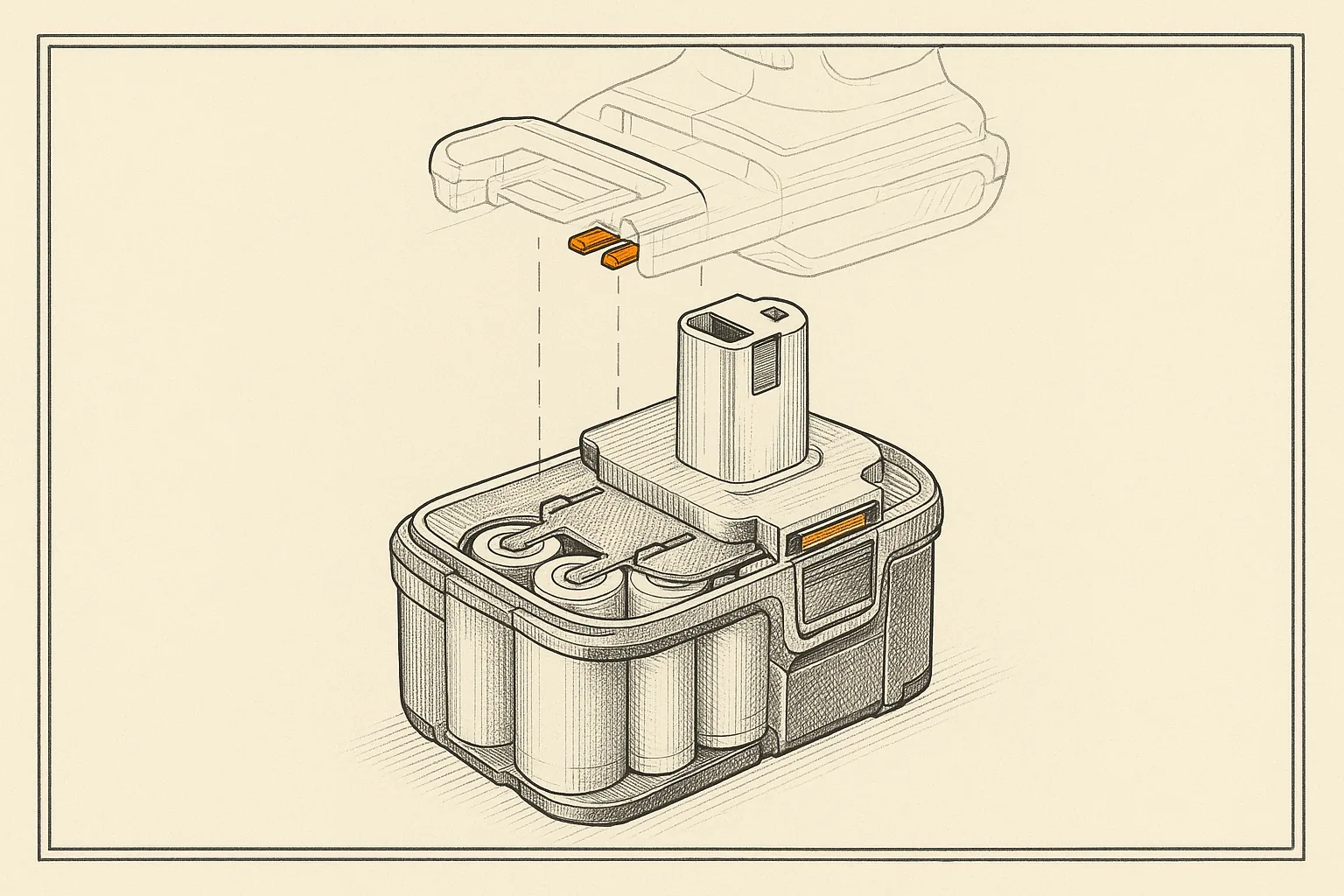
You are standing in the tool aisle holding a $99 drill kit, and it feels like a $99 decision. It isn't. The battery pack in that box only fits one brand's tools, so the kit you are holding is also the first page of a contract: every cordless saw, grinder, blower and impact driver you buy for the next decade will either share that pack or start a second, incompatible collection of packs and chargers. Tool people call this the platform decision, and it is the one cordless purchase worth slowing down for — not because any of the big systems is bad, but because leaving one later is expensive in a way the price tag on tool number one never shows.
This guide is an audit, not a diary. As explained in How We Source, we don't run a test lab, and we won't pretend to: every figure below traces to a manufacturer's own catalog page or warranty document, a published safety standard, or a named outside source, and each claim carries a numbered marker keyed to the Sources Ledger at the foot of the page.
The decision, up front #
There is no "best platform." There is a fork — who else's money is riding on your choice, and how many tools will end up on it? A pro whose crew and repair turnaround depend on the system weighs warranty terms and service; a homeowner buying four tools over five years mostly needs breadth at low prices. Here is how the fork resolves by situation, from the makers' own documents — each verdict with its downside stated:
- First-house DIYer: Ryobi 18V ONE+ is the homeowner-priced system with the longest compatibility story — Ryobi's own page counts over 300 compatible products and traces ONE+ battery compatibility back to 1996[3], and its tools, batteries and chargers all carry the same 3-year limited warranty[11]. Downside: it is positioned and priced as a DIY line, not a trade-duty one, and no document on this page can tell you it will survive jobsite abuse — see what the evidence doesn't cover.
- Apprentice or first-year trades: the practical shortlist is the two systems your future crews most likely already run, DeWalt 20V MAX ("300+ 20V products and growing"[1]) and Milwaukee M18 ("over 250 solutions"[4]). Milwaukee's cordless tools carry the longest tool warranty of the four, five years[8]. Downside: pro-tier pack prices — and note that Milwaukee's compact packs carry only a 2-year warranty against 3 for the big ones[9].
- Small contractor: the platform is a business asset, so audit it like one: warranty terms are in the table below, and the switching-cost worksheet puts a number on what you already have invested where you are. Downside of every answer here: the more bare tools you own, the more the exit costs — that is what lock-in means.
- Homesteader or rural property owner: weight the count of outdoor power equipment, not the headline number. Makita's LXT page claims the largest count of the four, over 350 products, and the system spans OPE and twin-pack 36V (2×18V) tools — but the same system's catalog also runs to lighting, dust extraction and even jobsite apparel, so the number is not a tool count[2]. Downside for all brands: yard tools are exactly where the watt-hour arithmetic below bites hardest.
- Renter: the smallest kit you can buy into, or no platform at all — a corded drill has no pack to age out while your tool needs are still small. Downside: you give up the convenience that makes cordless the default for everyone else, and if you buy in later you start from zero.
What a battery actually is: the amp-hour, demystified #
18 V × 5.0 Ah = 90 Wh · 18 V × 2.0 Ah = 36 Wh Arithmetic — the watt-hour is the number that lets packs be compared at all
Inference The number on the pack's label everyone shops by — amp-hours — is only half of an energy figure. Multiply it by the system's nominal voltage and you get watt-hours, the actual size of the tank. A 5.0 Ah pack on an 18V-class platform holds 90 Wh by label math; a 2.0 Ah compact pack holds 36 Wh. That one multiplication is what makes the dollars-per-watt-hour comparison in the next section possible.
Spec And the voltage classes are less different than the marketing suggests. DeWalt's "20V MAX" carries an asterisk on its own packaging and battery pages: "Maximum initial battery voltage (measured without a workload) is 20 volts. Nominal voltage is 18."[5] The 20V MAX system and the 18V systems are the same nominal voltage class, measured at different moments — a point tool publications have documented at length[6][7]. Volts are not a scoreboard here; the platform choice is about everything else.
The evidence table: four platforms, from their own documents #
Spec These are the four makers' own claims, retrieved 2026-08-05. Two warnings before you read them as a scoreboard: each count is the maker's marketing tally of "products" or "solutions," defined however the maker likes — Makita's LXT catalog extends to lighting, dust extraction and jobsite apparel[2] — and these numbers change as catalogs grow. Treat them as orders of magnitude, not rankings.
| Platform | Maker's own count | Tool warranty | Battery warranty | Source |
|---|---|---|---|---|
| DeWalt 20V MAX | "300+ 20V products and growing" | 3-yr limited + 1-yr free service + 90-day money-back | 3-yr free service contract | [1] [10] [12] |
| Makita 18V LXT | "over 350" products (system spans OPE, 2×18V, lighting, apparel) | 3-yr (all lithium-ion tools) | 3-yr (batteries and chargers) | [2] [13] |
| Milwaukee M18 | "over 250 solutions" | 5-yr (cordless M12/M18 tools) | 3-yr XC and High Demand packs (incl. High Output XC); 2-yr compact and CP packs (incl. High Output CP) | [4] [8] [9] |
| Ryobi 18V ONE+ | "over 300+ compatible products"; compatibility since 1996 | 3-yr limited (incl. OPE) | 3-yr limited (batteries and chargers) | [3] [11] |
Two things in that table are worth saying out loud. First, on breadth, all four systems clear the bar where breadth stops mattering for most buyers — every one of them covers drills, saws, grinders, blowers and lights many times over. Second, the warranty column is the closest thing this product class has to a published durability claim: it is the one number in the table a maker pays for when it is wrong. Milwaukee's 5-year tool warranty is the outlier on tools[8]; Makita's 3 years is notable for covering tools, batteries and chargers under one term, a policy it announced effective October 1, 2015[13].
The reasoning: packs are the profit center #
Inference Here is the arithmetic that explains why the platform decision matters more than any single tool purchase. Battery-teardown hobbyists — who buy packs to harvest the cells inside — have long documented power-tool pack pricing; a Milwaukee 18V 5.0 Ah pack (about 92.5 Wh by cell-nominal voltage, 18.5 V × 5.0 Ah) has sold in the $60–65 range, which works out to roughly $0.65 per watt-hour[14]. Brand-name packs at retail often run higher. At that reference rate, energy is the expensive part of every cordless purchase:
- Two 5.0 Ah packs ≈ 185 Wh ≈ $120 of battery at the reference rate — often more than the bare tool they power.
- Bare tools are priced low precisely because they are useless without the brand's packs; the packs, not the tools, carry the margin. That is the economic structure of lock-in, visible right in the price list.
- Packs are also consumables. The commonly documented service life for lithium-ion packs of this type is roughly 800–1,000 charge cycles[14], after which capacity fades — so a platform is not a one-time purchase but a slow subscription to replacement packs.
- Put together: a first cordless tool plus two packs and a charger commonly lands near the price of two or three corded equivalents. You are not overpaying — you are buying a portable energy system — but you should know that is what the money bought.
The switching-cost worksheet #
Inference Lock-in is not a feeling; it is a number you can compute in three lines. No pack fits another brand's tools — each maker's compatibility promise in the table above is explicitly within its own system[1][2][3][4] — so leaving means replacing the energy, the chargers, and the power source for every bare tool you keep. Price your own exit:
(YOUR PACKS: total Wh × ~$0.65/Wh, or the brand's shelf price)
+ (YOUR CHARGERS: replacement price × count)
+ (YOUR BARE TOOLS: rebuy, or resale haircut, × count) Reference rate from teardown-community pricing[14] — check current shelf prices before deciding anything
A worked example, at the reference rate: an owner with two 5.0 Ah packs and two 2.0 Ah packs holds 2×90 + 2×36 = 252 Wh, roughly $164 of energy — before a single charger or tool. Add a charger and, say, six bare tools that would need replacing or selling at a loss, and a casual mid-platform collection carries an exit bill in the high hundreds of dollars. That number grows with every bare-tool purchase, which is why the cheap bare tool is both the platform's best feature and its trap. The practical rule that falls out: pick the platform before tool two, not after tool five — the worksheet only gets worse.
Where the cord still wins #
Inference A platform is not a religion, and the watt-hour arithmetic draws its boundary honestly. One listed 11 A corded angle grinder draws 1,100 W from the wall[15]. A 5.0 Ah pack's ~90–92.5 Wh feeding that draw lasts about five minutes: 92.5 Wh ÷ 1,100 W × 60 ≈ 5.0 minutes. No pack in the class stores even ten minutes of that tool's appetite, which is why long grinding sessions stay corded and cordless owns intermittent work — the full arithmetic is in our angle grinder guide. Welding is further still out of reach: TIG duty-cycle wattages are measured in kilowatts, so that tool stays on the wall, period. Buy the platform for the work that is genuinely intermittent and portable; keep a cord for the work that isn't.
The safety file #
Standard Cordless tool construction — including lawn-and-garden machinery — is certified under the harmonized IEC/UL/CSA 62841 series, "Electric Motor-Operated Hand-Held Tools, Transportable Tools and Lawn and Garden Machinery — Safety," which includes requirements for lithium-ion cells and battery systems and has the pack and charger evaluated as a complete system[16][17]. A recognized certification mark on the tool and pack is part of what the platform price buys. Note also that every warranty document cited on this page covers the maker's own system used as a system; cross-brand adapters and off-brand packs sit outside all of them — whatever an adapter saves, it spends your warranty.
What breaks #
- Packs age out. The documented failure mode of a battery platform is not a dramatic one — it is capacity fade across the commonly cited ~800–1,000 charge cycles[14]. Budget for replacement packs as an operating cost, not a surprise.
- Small packs are warranted shorter. Milwaukee's own warranty schedule gives its compact and CP packs (including High Output CP) 2 years against 3 for the XC and High Demand packs (including High Output XC)[9]. Read that the way we do — as the maker pricing its own confidence — but read it as our inference, not Milwaukee's statement.
- Warranties demand paperwork. Every warranty document cited here conditions service on dated proof of purchase through the maker's own channels[10][11][13]. Keep receipts; the warranty column of the table is worth exactly as much as your ability to invoke it.
What the evidence doesn't cover #
Owning the gap is part of the method here, so: we know of no published, controlled, cross-brand test of pack longevity at scale — the ~800–1,000 cycle figure is community-documented, not a lab result we can hand you. The catalog counts in the evidence table are marketing tallies with no common definition, so a 350 and a 250 cannot be honestly ranked against each other. Pack prices move constantly, so the $0.65/Wh reference is a dated anchor for arithmetic, not a quote. And nothing in any document tells you how a platform's tools feel in your hands, or which brand's local service counter is actually fast — the two questions owners argue about most. Where those gaps matter to you, this page cannot close them, and it won't pretend to.
Sources Ledger #
- DeWalt, 20V MAX system page — "300+ 20V products and growing" (retrieved 2026-08-05). dewalt.com.
- Makita, 18V | 36V LXT system page — "over 350" cordless products; billed as the world's largest compatible 18V slide-style battery system; the system spans OPE and 2×18V tools, and its catalog runs to lighting, dust extraction and jobsite apparel (retrieved 2026-08-05). makitatools.com.
- Ryobi, 18V ONE+ system page — "over 300+ compatible products"; ONE+ battery interface compatibility since 1996 (retrieved 2026-08-05). ryobitools.com.
- Milwaukee Tool, M18 FUEL combo kit product page — "fully compatible with the MILWAUKEE M18 18-volt cordless system, featuring over 250 solutions"; "One System, 250+ Tools" (retrieved 2026-08-05). milwaukeetool.com.
- DeWalt, DCB205 20V MAX 5.0 Ah battery product page — the voltage disclaimer: "Maximum initial battery voltage (measured without a workload) is 20 volts. Nominal voltage is 18." dewalt.com.
- ToolGuyd, "Dewalt 20V Max = 18V Nominally" — the same disclaimer as printed on DeWalt packaging. toolguyd.com.
- Pro Tool Reviews, "20V Max vs 18V Batteries: Setting the Record Straight" — the voltage-class explanation. protoolreviews.com.
- Milwaukee Tool, registration and warranty page — cordless M12/M18 power tools carry a five-year limited warranty. milwaukeetool.com.
- Pro Tool Reviews, "Milwaukee Battery Warranty Period — Every Model and Pack Listed" — pack-by-pack compilation of Milwaukee's battery warranty documents: 3 years for M18 XC and High Demand packs, including High Output XC; 2 years for compact and CP packs, including High Output CP. protoolreviews.com.
- DeWalt, tool and product warranty page — 3-year limited warranty, 1-year free service contract, 90-day money-back guarantee. dewalt.com.
- Ryobi, warranty policies page — 3-year limited warranty covering 18V ONE+ portable power tools, bench/stationary tools, outdoor power equipment, batteries and chargers. support.ryobitools.com.
- DeWalt battery warranty sheet (distributed via Home Depot) — 3-year free service contract and 90-day money-back guarantee on 20V MAX batteries. warranty PDF.
- Makita, warranty page and 2015 press release — 3-year limited warranty on every Makita lithium-ion tool, battery and charger, effective 2015-10-01. makitatools.com/service/warranty; press release.
- Endless Sphere forum (battery teardown community) — documented power-tool pack pricing: Milwaukee 18V 5.0 Ah packs (~92.5 Wh by cell-nominal voltage) sold around $60–65, roughly $0.65/Wh; li-ion packs of this type commonly rated for ~800–1,000 charge cycles. endless-sphere.com.
- S.J. Smith catalog listing, 4-1/2 in.–5 in., 120 V, 11 A angle grinder — 1,100 W input / 720 W output. sjsmith.com.
- UL Solutions, announcement of the 62841 standard series for electric motor-operated hand-held tools, transportable tools and lawn and garden machinery — UL 62841-1 "includes new requirements for lithium-ion (li-ion) cells and battery systems" and requires the battery pack and charger to be evaluated as a complete system. ul.com.
- IAEI Magazine, "Navigating IEC/UL/CSA 62841 for Power Tool Safety" — the scope of the 62841 series, including the battery-system hazards it addresses. iaeimagazine.org.
Change notes #
Cite this page: "Picking a Cordless Battery Platform: The Lock-In Audit," Precious Handyman, updated 2026-08-05, https://precioushandyman.com/battery-platforms/