Buying guide · Garage
Air Ratchets: What the Spec Sheets Say Before You Buy
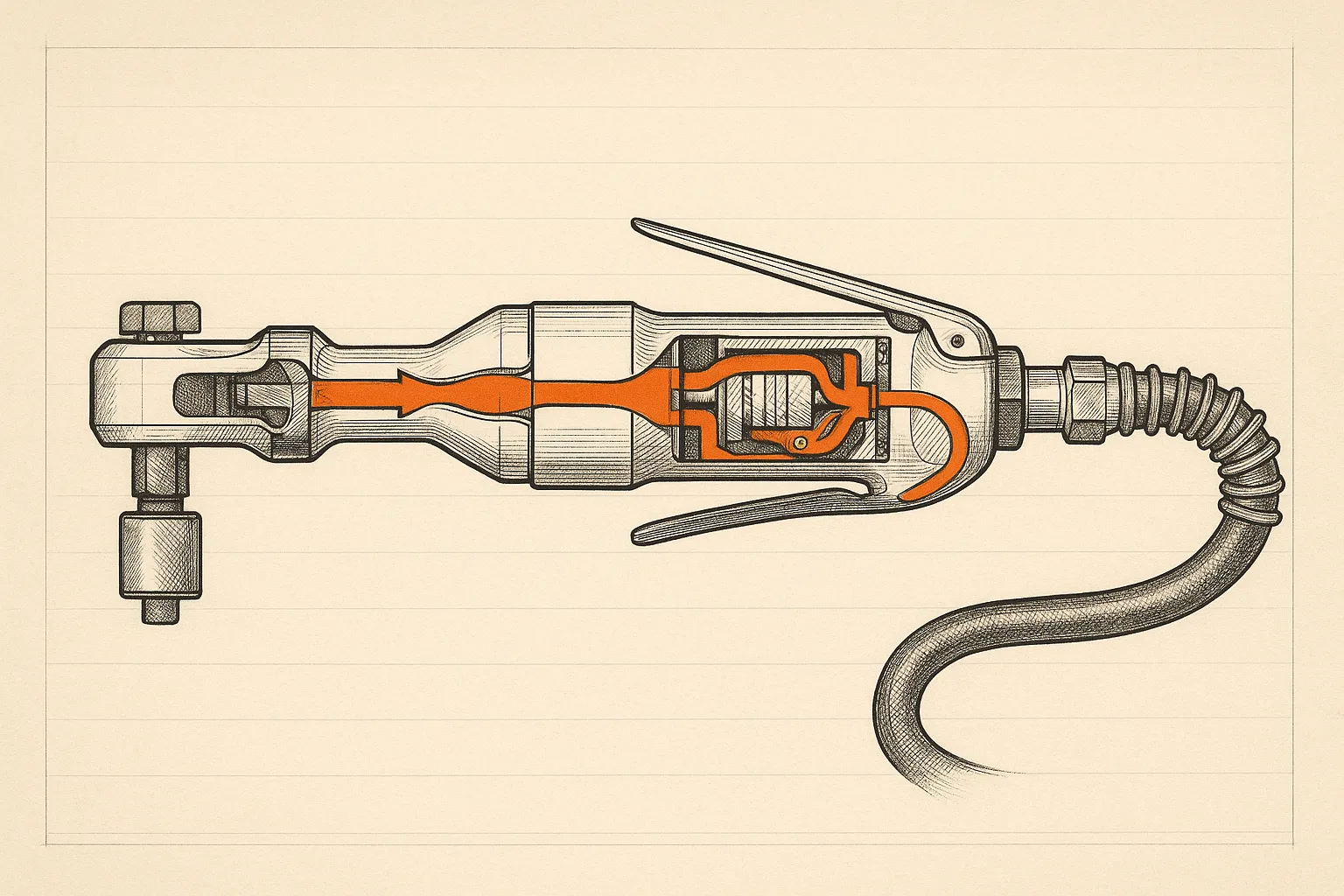
We don't run a test lab, and this guide will not pretend we wrenched on anything. What follows is an audit of the published record on air ratchets: the manufacturer's own data plate read line by line, the class norms from a named buying guide, the binding noise-exposure numbers from OSHA and NIOSH, and our arithmetic from those figures with the working shown. Every number carries a marker keyed to the Sources Ledger at the bottom.
The job: two bolts behind a wheel #
The caliper bracket is off, the new rotor is on, and now the bracket has to go back — two long bolts into the knuckle, in a wheel well where a hand ratchet swings maybe thirty degrees before it hits the strut. Click, reset, click, reset, thread by thread. Nothing about this job is hard. It is just slow, and it is slow four corners in a row.
That tedium is the entire case for an air ratchet. It is not a power tool in the brute-force sense; it is a patience machine. The question is whether the patience it saves is worth what it actually costs to feed one — and the spec sheets answer that more honestly than the marketing does.
The fork that decides it #
Do you already own a compressor that can feed it?
A common 3/8-inch air ratchet consumes 3–4.5 CFM and, in the words of the OnAllCylinders buying guide, "mandate[s] 90 psi (constant)"[3] — and the guide warns that "some small 110-volt portable compressors will struggle to keep up."[3] So the fork is the compressor, not the ratchet:
- Compressor on the wall already (a garage that runs an impact wrench, blow gun, or tire chuck): the benchmark Ingersoll Rand 107XPA listed at $119.95[2] plus a hose fitting is one of the cheapest speed upgrades in the shop. Downside: the tool works only at the end of that hose.
- No compressor: the compressor is the real purchase, and the ratchet is an accessory to it. Unless you want air for other reasons, a cordless ratchet on whatever battery platform you commit to — a decision with its own arithmetic — usually makes more sense than buying a compressor to spin bolts. Downside: platform buy-in, and batteries are the profit center.
By reader:
- First-house DIYer, no compressor: skip it. A hand ratchet does everything this tool does, slower. Buy speed only after the slow jobs become frequent.
- Apprentice in a shop with air: the classic case. Shop air is paid for; the marginal cost is the tool itself. Mind the noise numbers in the safety file — you are the one standing next to it all day.
- Small contractor working off a truck: hoses don't travel light. Cordless wins on mobility even where air wins on price.
- Homesteader: if a compressor is already justified by tires, blow-down, and an impact wrench, the ratchet rides along cheap. Check the compressor's delivered CFM at 90 PSI against the tool first — the math is below.
- Renter with shared walls: a 94.4 dB(A) tool[1] fed by a compressor is two noise sources your neighbors did not agree to. Hand tools, or a quiet cordless ratchet.
What an air ratchet is — and is not #
An air ratchet looks like a hand ratchet with a grip full of air motor, and that is what it is: the motor turns the square drive continuously, at low speed and modest torque. An impact wrench is a different machine — as tool retailer JB Tools describes the mechanism, air "drives an internal impact mechanism, which creates rapid bursts of rotational force."[4] Those hammer blows are what let an impact wrench crack fasteners far beyond anything a ratchet touches, and they are also why an impact barely twists your wrist while a ratchet hands you the reaction.
The numbers make the division of labor plain. The 107XPA's manufacturer sheet gives a recommended torque range of 10–45 ft-lb[1], and the OnAllCylinders guide puts most standard 3/8-inch air ratchets at "about 30–50 foot-pounds," noting that "might not be sufficient to crack open (or seriously tighten) many fasteners."[3] Caliper bracket bolts, lug nuts, suspension hardware — the breaking-loose and the final tightening belong to a breaker bar, an impact, and a torque wrench. The ratchet owns the middle of the job: the fast spinning between loose and tight, in spaces where a hand ratchet swings thirty degrees at a time.
Inference One practice note that follows from the specs rather than from any test: nothing on an air ratchet reads out the torque it delivered, and the same is true of an impact wrench. On any fastener with a published torque figure — and brake hardware always has one in the service manual — run it down with the ratchet, then set final torque with a hand torque wrench against that figure.
The benchmark plate, line by line #
The Ingersoll Rand 107XPA is the standard-issue 3/8-inch air ratchet — the one whose figures the rest of the class gets measured against. Here is its data plate, assembled from the manufacturer's product-information sheet (form 80177587, ed. 4, January 2014)[1] and a stocking distributor's listing[2]:
FREE SPEED 160 RPM · RECOMMENDED TORQUE 10–45 FT-LB
SOUND PRESSURE 94.4 dB(A) · ISO 15744 Source: Ingersoll Rand Product Information 80177587 ed. 4 [1]
| Plate line | Figure | Grade | Source |
|---|---|---|---|
| Drive | 3/8 in. square | SPEC | IR sheet [1] |
| Free speed | 160 RPM | SPEC | IR sheet [1] |
| Recommended torque range | 10–45 ft-lb (14–61 Nm) | SPEC | IR sheet [1] |
| Maximum torque | 54 ft-lb | SPEC | Dillon Supply listing [2] |
| Air flow, free speed | 19 CFM | SPEC | Dillon Supply listing [2] |
| Air inlet | 1/4 in. NPT | SPEC | Dillon Supply listing [2] |
| Minimum hose size | 3/8 in. | SPEC | Dillon Supply listing [2] |
| Sound pressure (Lp) | 94.4 dB(A), ISO 15744 | SPEC | IR sheet [1] |
| Sound power (Lw) | 105.4 dB(A), ISO 15744 | SPEC | IR sheet [1] |
| Vibration | < 2.5 m/s², ISO 28927 | SPEC | IR sheet [1] |
| Overall length | 11 in. | SPEC | Dillon Supply listing [2] |
Three of those lines do the real talking. 160 RPM is slow for a power tool and exactly right for threading: fast enough to erase the click-and-reset tedium, slow enough to feel a bolt go tight. 10–45 ft-lb recommended is the honest working envelope — note that the manufacturer's own recommended ceiling sits below the 54 ft-lb maximum in the retail listing, a gap worth remembering before you lean on "max torque" in anyone's headline. And 19 CFM at free speed is the line that quietly indicts half the compressors it will get plugged into, which brings us to the arithmetic.
A receipts note: retail listings for this exact tool disagree with each other — one major listing's title calls the 107XPA a "73 ft-lb" tool while the manufacturer's sheet and the distributor listing above say 10–45 recommended and 54 maximum[1][2]. When a listing and the manufacturer's document disagree, this site prints the document.
The compressor is the real price #
Air tools are priced like accessories because they are: the motor you are really buying sits on the floor in the corner. Per OnAllCylinders, most common 3/8-inch air ratchets "consume 3 to 4.5 cfm of air and mandate 90 psi (constant)," want a 3/8-inch minimum line, and connect through a 1/4-inch NPT coupler[3] — figures that match the 107XPA's plate[2].
Inference Here is how to read those numbers against a compressor, working only from the cited figures. A compressor's useful rating is the CFM it can deliver at 90 PSI — the number on its own spec sheet, usually well below the marketing "peak" figure. The ratchet's 3–4.5 CFM average[3] is what it draws across a job of short bursts; its 19 CFM at free speed[2] is what it swallows while a loose bolt is actually spinning. The tank is a buffer that absorbs those bursts; the pump's delivered CFM is the budget that refills it. If delivered CFM at 90 PSI is below the tool's average draw, the tank drains job by job and you stand there waiting for the pump to catch up — which is the failure OnAllCylinders is describing when it says small 110-volt portables "will struggle to keep up," while "a capable 220 (240) volt two-stage air compressor" powers "an air ratchet or two simultaneously" without issue[3].
The supporting cast costs money and matters. The manufacturer's installation instructions call for a supply line sized to hold operating pressure at the tool inlet, daily draining of condensate from the piping, filter, and compressor tank, a properly sized Safety Air Fuse upstream of the hose, and an anti-whip device across any hose coupling without an internal shut-off[1]. The OnAllCylinders guide adds the in-line oiler, kept filled with air-tool oil, as the cheap insurance that "increases tool life" on every air tool[3]. None of these is expensive; all of them belong in the honest total.
Air vs. cordless: the total-cost fork #
Inference The comparison that matters is not tool against tool — it is system against system, and it splits cleanly on one question already asked above.
If the compressor exists, the air side of the ledger is short: a $119.95 benchmark tool[2], a coupler, and a few dollars of oiler and oil. The air tool never needs a battery charged and has no pack to age out, and it stays light — the 3/8-inch ratchets the OnAllCylinders author offers as a size reference weigh 2.65 pounds each[3], with no battery hanging off the grip. Its leash is the hose, and its noise is the tool plus the compressor behind it.
If the compressor does not exist, the air ledger inherits the compressor's entire cost — purchase, circuit, floor space, maintenance — and the cordless ledger starts looking like the cheap one even though cordless ratchets cost more per tool. But the cordless ledger has its own below-the-line entry: the battery platform. Packs and chargers are where the money goes, packs wear out with charge cycles, and no brand's packs fit another brand's tools, so the first cordless tool is really a vote for an ecosystem. That decision has its own audit on this site; this guide only insists you count it. What we will not do is quote a speed comparison between the two: we found retailer claims but no published test with a stated method behind them, so no number appears here — details in the gaps box.
The safety file: 94.4 dB(A) is a number with rules attached #
The 107XPA's sheet declares 94.4 dB(A) sound pressure at the operator, measured per ISO 15744[1]. That number lands in territory the safety standards regulate explicitly.
Standard OSHA's occupational noise rule, 29 CFR 1910.95, permits 8 hours per day at 90 dBA, 6 hours at 92, and 4 hours at 95 (Table G-16), and sets an "action level" at an 8-hour average of 85 dBA, at or above which a workplace must run a hearing-conservation program[5]. A 94.4 dBA tool sits just under the 4-hour line.
Standard NIOSH — the research agency, whose recommendations are stricter than OSHA's floor — sets its recommended exposure limit at 85 dBA over 8 hours with a 3-dB exchange rate, meaning every 3 dB louder halves the recommended time[6]. Inference Run that formula at this tool's level: 8 ÷ 2^((94.4 − 85) / 3) ≈ 0.9 hours. By the NIOSH criteria, an unprotected ear gets less than an hour a day at an open 107XPA throttle — before adding the compressor cycling behind you.
The manufacturer's own caveat cuts the honest direction: the sheet warns that its sound and vibration values were measured under standardized test conditions and that exposure "in a specific tool application may vary from these results," so on-site measurement should set the hazard level[1]. In a concrete-walled garage, assume worse than the plate. Hearing protection whenever the tool runs is the cheap answer; so is the hose-whip hardware from the same sheet — the Safety Air Fuse and anti-whip device[1] — because a failed coupling turns a pressurized hose into a whip. And on brake work specifically: the ratchet threads, the torque wrench finishes, per the service manual's figure. Speed is not worth a guessed caliper bolt.
What breaks #
- Wrists, colloquially. The OnAllCylinders guide warns that a too-light air ratchet "can be troublesome (some mechanics call them 'wrist breakers')"[3] — with no impact mechanism, the reaction torque when a fastener seats goes into the hand holding the tool. Weight and a longer body are the buyer's lever against it.
- Starved tools. An undersized compressor or a skinny hose shows up as a ratchet that stalls under load — the supply-line sizing instruction on the manufacturer's sheet[1] and the 3/8-inch minimum hose on the plate[2] exist because the symptom gets blamed on the tool.
- Dry and wet motors. The maintenance the manufacturer schedules — oiling, and daily condensate draining out of the piping, filter, and tank[1] — is the maintenance that, skipped, feeds an air motor unlubricated air and water. The in-line oiler OnAllCylinders recommends is the set-and-check version of the same insurance[3].
- Over-trusted torque. Inference The gap between the 54 ft-lb maximum[2] and the 10–45 ft-lb recommended range[1] is where small fasteners get stretched and gun-tightened bolts get left un-torqued. The tool reports nothing; the torque wrench does.
What the evidence doesn't cover #
- No instrumented cross-brand test. Unlike angle grinders or string trimmers, we found no published independent shootout of air ratchets with a stated method — no measured torque, speed, or air-consumption comparison across brands we could cite. Class norms here come from a named buying guide[3], not from testing.
- No citable air-vs-cordless speed number. Retailer copy circulates claims that air ratchets are dramatically faster than cordless ones; we could not trace any such figure to a published test writeup, so this guide makes no speed claim in either direction.
- Durability is unpublished. Nothing in the manufacturer sheet or listings speaks to service life. The repair-friendliness of a serviceable air motor versus a sealed cordless tool is a plausible argument we cannot quantify from the record.
- Lab noise is not your garage's noise. The 94.4 dB(A) figure is an ISO 15744 measurement, and the manufacturer itself says application exposure may vary[1]. Our exposure arithmetic inherits that limit.
Sources Ledger #
- Ingersoll Rand, Air Ratchet Wrench 107XPA and 1077XPA — Product Information, form 80177587, edition 4, January 2014. Specifications table (drive, free speed, recommended torque range, sound per ISO 15744, vibration per ISO 28927), installation and lubrication instructions, and the sound-measurement caveat. Manufacturer PDF, as distributed by Dillon Supply.
- Dillon Supply, product listing: "Ingersoll-Rand 107XPA Standard Air Ratchet Wrench, 3/8 in Drive, 54 ft-lb Torque, 160 rpm Speed, 19 cfm Air Flow" — max torque, air flow, inlet, minimum hose, overall length, and the $119.95 price, retrieved 2026-08-05. dillonsupply.com
- Wayne Scraba, "How to Choose the Best Air Ratchets for Your Garage," OnAllCylinders (Summit Racing Equipment), December 28, 2018. Class torque norms, CFM and 90 PSI requirements, drive sizes, compressor cautions, weight reference, "wrist breakers," and the in-line oiler practice. onallcylinders.com
- JB Tools, "Air Impact Wrench vs Cordless Impact Wrench" — cited only for its description of the impact mechanism ("rapid bursts of rotational force"), retrieved 2026-08-05. jbtools.com
- OSHA, 29 CFR 1910.95, Occupational noise exposure — Table G-16 permissible exposures and the 85 dBA action level at 1910.95(c)(2). osha.gov
- NIOSH, Criteria for a Recommended Standard: Occupational Noise Exposure, DHHS (NIOSH) Publication No. 98-126, 1998 — the 85 dBA recommended exposure limit and 3-dB exchange rate. cdc.gov/niosh
Cite this page: "Air Ratchets: What the Spec Sheets Say Before You Buy," Precious Handyman, updated 2026-08-05, https://precioushandyman.com/best-air-ratchet/