Buying guide · Power tools
Angle Grinders: The Numbers That Keep the Wheel Together
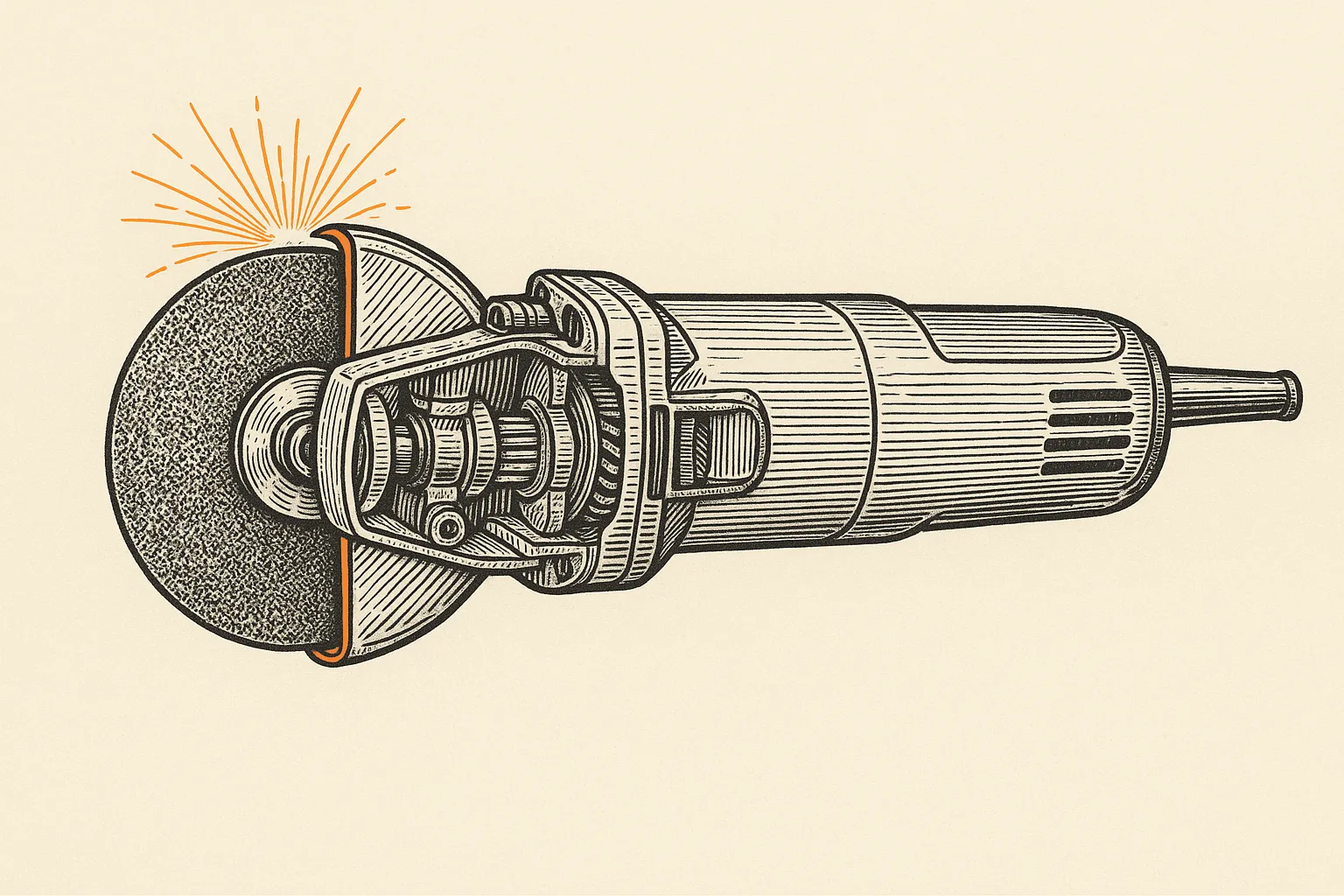
The carriage bolt holding the fence-gate bracket has been rusting into its nut for fifteen years, and the wrench just rounded what was left of the head. You can fight it for an hour with penetrating oil and a breaker bar, or an angle grinder with a cut-off wheel can end the argument in about ten seconds. The same tool will then dress the burr off the cut, strip the paint around the bracket, and sharpen the mower blade on the way back to the shed — which is why it is usually the first "real" power tool people buy after a drill.
This guide is an audit, not a diary. As explained in How We Source, we don't run a test lab, and we won't pretend to: every figure below traces to a manufacturer spec sheet, a published safety standard, or a named independent test, and each claim carries a numbered marker keyed to the Sources Ledger at the foot of the page.
The decision, up front #
There is no "best angle grinder." There is a fork, and it is not about brands: how long is the wheel actually in the work? A corded grinder draws power continuously from the wall for as long as you lean on it; a cordless one carries a small, expensive tank of energy that sustained grinding drains quickly (the arithmetic is below). Here is how that fork resolves by situation — each verdict with its downside stated:
- First-house DIYer: a corded 4-1/2 in. grinder in the standard 11,000 RPM class. It is the cheapest way to own the full capability, and there is no battery to age out. Downside: you manage a cord, and the cheapest units in the class measurably trail the field in independent testing[10].
- Renter: same corded answer, smaller budget pressure — but note that in Project Farm's comparisons the $15 to $27 budget units trailed badly[10]. Downside of buying up: money spent on a tool a landlord's problems may rarely need.
- Apprentice or small contractor already on a battery platform: the cordless grinder from that platform, for intermittent cuts where dragging a cord costs more time than swapping a pack. Downside: packs, not the bare tool, are the real price, and sustained grinding outruns them (arithmetic below).
- Homesteader: the honest answer is eventually both — corded at the bench for long sessions, cordless for the fence line beyond the last outlet. Downside: that is two purchases, and this site will not pretend otherwise.
Whichever branch you take, the rest of this guide is about the numbers that keep the spinning wheel in one piece — because the specs that matter most on a grinder are safety specs.
The number that matters is rim speed, not RPM #
Spec A grinding wheel is not rated by RPM in the abstract. It is rated by peripheral speed — how fast the rim of the wheel is moving through space — and most hand-held bonded abrasive wheels are rated at 80 meters per second[4]. RPM and rim speed are linked by the wheel's circumference, so the maximum safe RPM stamped on a wheel falls as its diameter rises:
| Wheel diameter | Approx. max RPM at 80 m/s | Source |
|---|---|---|
| 4-1/2 in. | ~13,300 RPM | Whitby Abrasives [4] |
| 5 in. | ~12,200 RPM | Whitby Abrasives [4] |
| 9 in. | ~6,650 RPM | Inference — arithmetic shown below |
Inference The arithmetic behind the table, shown: rim speed = circumference × rotational speed. A 4-1/2 in. wheel is 0.1143 m across, so its circumference is π × 0.1143 ≈ 0.359 m. At 11,000 RPM the rim covers 0.359 × 11,000 ≈ 3,950 m per minute, which is about 66 m/s — comfortably inside the 80 m/s rating. Run the same numbers on a 9 in. wheel (circumference ≈ 0.718 m) at 11,000 RPM and the rim is doing roughly 132 m/s.
That last figure is why the rule exists. Spec ANSI B7.1's scheme carries a nominal burst-safety factor of about 1.5× the marked speed — a proof-burst speed of 120 m/s for an 80 m/s wheel — plus a production over-speed test at 110% or more of marked speed before a wheel ships; the European EN 12413 standard's representative factor is 1.73× (138.4 m/s), with product-specific factors running roughly 1.32× to 1.87× by product and machine type[4][5]. A 9 in. wheel spun at a small grinder's 11,000 RPM is doing about 132 m/s — past the 120 m/s ANSI proof-burst speed for its rating class, on a stress term that rises with the square of speed. This is the classic overspeed error — a wheel rated in the 6,600 RPM range mounted on a spindle turning nearly twice that — and Whitby's summary of it is blunt: it can shatter the wheel within seconds[4].
Spec The physics is unforgiving because centrifugal stress scales with the square of speed — doubling RPM quadruples the load on the wheel's bond[4]. And a wheel that lets go does not fail politely: it shatters, sending sharp fragments flying at high velocity across the workspace[6]. The practical rules that fall out of the numbers: never mount a wheel whose stamped maximum RPM is below the grinder's no-load speed, and never mount a larger wheel than the grinder was guarded and rated for, even if it physically fits the spindle.
The class you are actually buying #
Spec The standard small grinder in North America is a remarkably uniform commodity: a 4-1/2 in. wheel, 11,000 RPM no-load speed, and a 5/8"-11 spindle thread. Makita's GA4530 lists 11,000 RPM and a 5/8-11 spindle on its manufacturer sheet, and Milwaukee's 11 A 6146-31 lists the same 11,000 RPM[8]; the 11 A machine on the catalog plate below — a Metabo — reads 11,000 and 5/8-11 as well[9]. DeWalt lists some of its small grinders at 12,000 RPM — the 9 A DWE4120, for instance[8]. (Check the 12,000 RPM figure against the table above: on a 4-1/2 in. wheel that is still only about 72 m/s at the rim — inside the 80 m/s rating. The margin is engineered into the class.)
120 V · 11 A · 1,100 W INPUT · 720 W OUTPUT
11,000 RPM NO-LOAD · 7,500 RPM RATED-LOAD · 5/8-11 SPINDLE S.J. Smith catalog listing[9]
Two things worth noticing on that plate. First, the no-load number on the box is not the speed you grind at: this machine is rated at 7,500 RPM under load, a third lower[9]. Second, input and output power are both listed — 1,100 W drawn from the wall, 720 W delivered to the wheel[9]. Manufacturers usually advertise the bigger number. When you compare grinders, compare like with like, and treat a spec sheet that lists only amps as listing input, not output.
Corded vs cordless: the wall-draw arithmetic #
Inference Here is the whole corded-versus-cordless question in three lines of arithmetic, using the 11 A grinder above:
- Its wall draw is 1,100 W[9]. Ten minutes of continuous grinding at that draw is 1,100 W × 1/6 h ≈ 183 Wh of energy.
- A typical 18 V, 5.0 Ah battery pack stores 18 × 5.0 = 90 Wh (volts × amp-hours = watt-hours).
- So ten minutes of that grinder's full wall draw is roughly two entire 5.0 Ah packs — no pack in that class stores even ten minutes of it.
That is the honest boundary line. Corded still owns long grinding sessions — weld cleanup on a trailer frame, a day of tuckpointing — and cordless owns intermittent work: a cut here, a bracket there, anywhere the outlet isn't. Lithium-ion packs are also consumables on a long clock — commonly reckoned at several hundred to about a thousand charge cycles, a community-documented figure rather than a lab result, as our battery-platform audit spells out — so a cordless grinder's real cost includes the packs it will consume, not just the bare tool. Neither side of the fork is wrong; the fork is about your ratio of grinding minutes to walking minutes.
What independent testing found #
Tested The most useful published cross-brand grinder data we know of comes from Project Farm, a YouTube test channel with a stated and unusual funding rule: the tester buys every product tested — the grinder video's own description says "I always buy all of the products that I test to ensure an unbiased review"[10] — and declines all sponsorship offers, funding purchases through viewer support on Patreon instead[11] — which is why we treat the channel's results as citable independent testing.
The corded angle grinder shootout covered Hilti, Milwaukee, DeWalt, Makita, Ryobi, Ridgid, Metabo, Harbor Freight Warrior, Porter-Cable, and Black & Decker, and compared them on weight, noise, wheel stop speed, no-load RPM, start-up torque, tool vibration, and cutting speed through rebar with both a cut-off wheel and a grinding wheel[10]. On the channel's corded results page, the roughly $170 Makita finished best overall, while the $15-to-$27 budget units — Harbor Freight's Warrior and WEN — finished at the bottom of the field[10].
Read those results the way we do: they are measurements of new tools on specific tasks by one careful tester, not a lifetime reliability verdict. But they are the closest thing this product class has to a public, instrumented head-to-head, and they point the same direction as the spec sheets — the mid-priced, major-brand corded class delivers most of what the premium tier does, and the very cheapest units give up real cutting performance.
The safety file: what the rules actually require #
Standard Grinder guarding in the US is not advice, it is rule text. OSHA 29 CFR 1926.303 (construction) and 29 CFR 1910.215 (general industry) require abrasive-wheel guards conforming to ANSI B7.1, the "Safety Code for the Use, Care and Protection of Abrasive Wheels"[1][2]. The rule text still cites the 1970 edition; the standard has been revised through ANSI/UAMA B7.1-2017, and where the editions differ — guard exposure angles, for instance — OSHA treats following the newer edition as a de minimis matter[14]. In plain English, the rules require:
- The guard stays on. It must cover the spindle end, nut and flange projections, and the guard and its fastenings must be strong enough to retain the fragments if the wheel breaks (1926.303(b))[1]. A grinder with the guard removed to fit a bigger wheel violates both the mounting rule and the rim-speed math above at the same time.
- Inspect and sound wheels before mounting. OSHA's rule text requires every wheel to be closely inspected and "sounded" before mounting — the ring test: tap gently with a light nonmetallic implement, and a sound vitrified wheel gives a clear metallic tone where a cracked one sounds dead. The rule itself adds the caveat that organic-bonded wheels do not emit the same clear ring[2]. A dropped wheel is a suspect wheel[3].
- Cut-off wheels have their own guard file. OSHA maintains a standing directive, STD 01-12-026 ("Abrasive Operation Using Cutoff Wheels and Masonry Saws"), instructing its inspectors how to cite guards on abrasive cutoff wheels[7] — the cutting use that opened this guide is regulated down to the degrees of wheel a guard may leave exposed.
- The tool itself is certified separately. Electric grinder construction is certified to the harmonized IEC/UL/CSA 62841 series covering hand-held motor-operated tools[12][13]. A recognized certification mark on the nameplate is part of what you are paying for.
What breaks #
The documented failure modes of this tool class, sourced:
- Wheel burst — from overspeed (the wrong wheel on the wrong spindle, per the rim-speed section) or from mounting a damaged wheel; hence the inspect-and-sound rule[4][3]. Abrasive-wheel safety guides are blunt that a wheel must never be run above its rated speed, even if the tool can turn faster — burst is not reserved for gross overspeed[6].
- Kickback and binding in cut-off use — the standard warning text printed in grinder manuals defines kickback as "a sudden reaction to a pinched or snagged rotating wheel": a thin wheel pinched in a closing kerf stalls, and the tool is forced in the direction opposite the wheel's rotation. The same warning text orders you never to restart a cut with the wheel sitting in the kerf — let it reach full speed, then re-enter carefully[15]. That is why the fence-bolt cut in the opening paragraph deserves a firm two-handed grip and a stance out of the wheel's plane.
What the evidence doesn't cover #
Owning the gap is part of the method here, so: spec sheets say nothing about how a grinder holds up over years, and we know of no published large-sample reliability survey for angle grinders of the kind Consumer Reports runs for some other tool categories. The independent testing cited above measures new tools on defined tasks — it cannot tell you which brand's switch dies in year three. Ergonomics (paddle versus slide switch, grip diameter, vibration feel over an afternoon) are real purchase factors this page cannot settle from documents, because they are preferences, not published figures. Where those gaps matter to you, the honest move is to hold the candidates in a store — and nothing on this page substitutes for that.
Sources Ledger #
- OSHA, 29 CFR 1926.303, "Abrasive wheels and tools" (construction) — guard requirements incl. 1926.303(b)–(c). osha.gov rule text.
- OSHA, 29 CFR 1910.215, "Abrasive wheel machinery" (general industry). osha.gov rule text.
- United Abrasives Manufacturers' Association (UAMA), abrasive safety guide — safe-use DOs and DON'Ts, incl. "DO check all wheels for cracks or other damage before mounting" and "DON'T use wheels which have been dropped or damaged." uama.org.
- Whitby Abrasives, "Grinding Wheel Safety: Max RPM and ANSI B7.1" — 80 m/s off-hand cap, max RPM by diameter (~13,300 at 4-1/2 in., ~12,200 at 5 in.), speed-squared stress, proof-burst speeds for an 80 m/s wheel (120 m/s ANSI, 138.4 m/s EN, via the Fuji Grinding Wheel standards comparison), and the 6,600 RPM wheel-on-11,000 RPM-spindle example. whitbyabrasives.ca.
- Whitby Abrasives, "Abrasive Safety Standards: EN 12413, OSA, ANSI" — EN 12413 Table 4 burst factors (roughly 1.32× to 1.87× by product and machine type, 1.73× representative), ANSI's ~1.5× nominal factor and ≥110% production over-speed proof test. whitbyabrasives.ca.
- Benchmark Abrasives, "Understanding RPM Ratings on Abrasive Tools" — never exceed the rated speed even if the tool can turn faster; burst wheels send fragments flying at high velocity. benchmarkabrasives.com.
- OSHA Directive STD 01-12-026, "Abrasive Operation Using Cutoff Wheels and Masonry Saws" — inspection guidance on guards and angular exposure for abrasive cutoff wheels, under 1910.215, 1926.303 and 1926.702(i). osha.gov.
- Manufacturer listings for the 4-1/2 in. corded class: Makita GA4530 (11,000 RPM, 5/8"-11 UNC); Milwaukee 6146-31 (11 A, 11,000 RPM); DeWalt DWE4120 (9 A, 12,000 RPM, 5/8"-11).
- S.J. Smith catalog listing, 4-1/2 in.–5 in., 120 V, 11 A angle grinder — 1,100 W input / 720 W output, 11,000 RPM no-load / 7,500 RPM rated-load, 5/8-11 spindle. sjsmith.com.
- Project Farm, corded angle grinder comparison — brands, the measured tests listed in the archived video's description (weight, noise, wheel stop speed, no-load RPM, start-up torque, vibration, rebar cutting speed with cut-off and grinding wheels), the "I always buy all of the products that I test" statement, and the results table with prices and finishes. projectfarmreviews.com summary; archived video mirror.
- Project Farm, Patreon about page — declines all sponsorship opportunities; every penny of viewer donations spent on products tested, test equipment, or video expenses. patreon.com/projectfarm.
- UL Solutions, news item on the UL 62841 standard series — UL 62841-1 covers hand-held tools, transportable tools and lawn and garden machinery. ul.com.
- IAEI Magazine, "Navigating IEC/UL/CSA 62841 for Power Tool Safety" — scope and testing of the harmonized 62841 series for hand-held motor-operated tools. iaeimagazine.org.
- US Made Supply, "ANSI B7.1 Abrasive Wheel Safety" resource — current edition ANSI/UAMA B7.1-2017; OSHA's rule adopts the 1970 edition and treats newer-edition differences (e.g., cutoff-wheel guard exposure) as de minimis. usmadesupply.com.
- Makita GA4530 instruction manual — "Kickback and Related Warnings": kickback defined as a sudden reaction to a pinched or snagged rotating wheel; do not restart the cut in the workpiece. makitatools.com manual PDF.
Change notes #
Cite this page: "Angle Grinders: The Numbers That Keep the Wheel Together," Precious Handyman, updated 2026-08-05, https://precioushandyman.com/best-angle-grinder/