Craft · Where the skills live
Where Hand-Tool Craft Is Still Taught
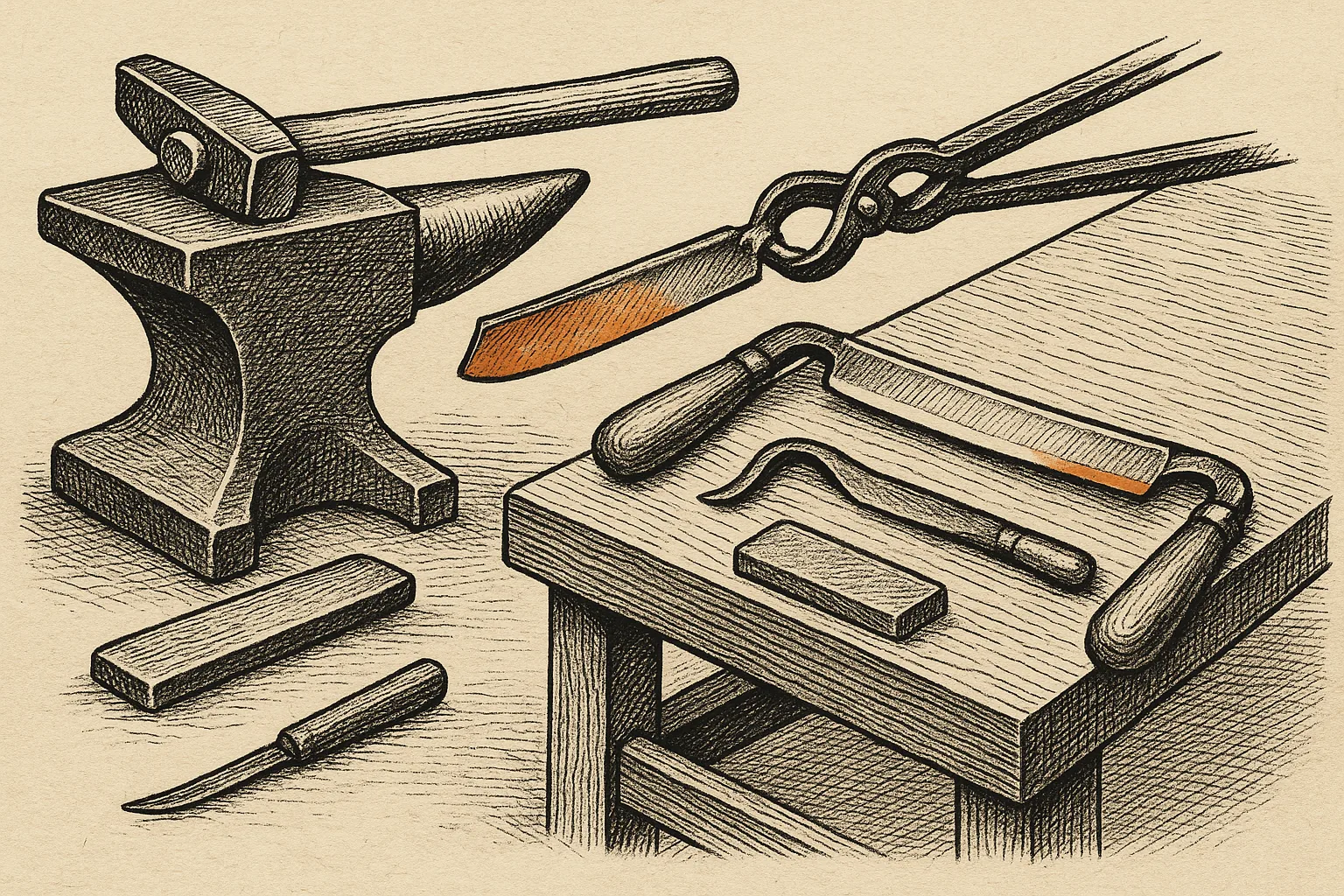
There is a drawknife in a box in your garage. It came from a grandfather or an estate sale, the edge is somewhere between dull and damaged, and no store you can drive to employs anyone who can show you how to bring it back. That gap — between owning a hand tool and knowing what to do with it — is not closed by another purchase. It is closed by instruction, and instruction in hand-tool craft still exists, on published schedules, at real addresses. This page is a documented tour of where.
The rest of this site audits spec sheets. This page audits curricula — the courses these schools themselves publish — plus one case study from the other side of the planet. As explained in How We Source, we don't run a test lab and we have not attended these schools; every claim below is read from the institutions' own published pages or a named outside source, each keyed to the Sources Ledger at the foot of the page.
What a folk school is #
Spec The institutions that kept hand-tool teaching alive in the United States mostly share one ancestor: the Danish folkehøjskole, the "folk high school." John C. Campbell Folk School's own history tells the founding story plainly: after John C. Campbell died in 1919, his widow Olive Dame Campbell and her friend Marguerite Butler "traveled to Europe and studied folk schools in Denmark, Sweden, and other countries," then opened their own in the Appalachian community of Brasstown, North Carolina, in 1925[2].
Spec The model's defining rule is the absence of a scoreboard. The school's history page states: "Instruction at the Folk School has always been noncompetitive; there are no credits, no grades, no pitting of one individual against another."[2] North House Folk School in Minnesota describes the same inheritance — learning without exams, credits or term papers, drawn from "Scandinavian folkehøjskolers (folk high schools)"[4]. For an adult who wants to learn sharpening or forging without enrolling in anything that issues transcripts, this is the format that was built for exactly that.
The schools, on the record #
Spec These are institutional claims from each organization's own site, retrieved 2026-08-05. Course catalogs and counts change season to season; treat the numbers as each school's own description, dated, not our tally.
| Institution | Where | Since | What its own pages say | Source |
|---|---|---|---|---|
| John C. Campbell Folk School | Brasstown, NC | 1925 | 270-acre campus; "weeklong and weekend classes for adults" including blacksmithing, woodworking and woodturning | [1] [2] |
| North House Folk School | Grand Marais, MN | 1997 | "over 350 classes and 3,000 students per year"; catalog categories include Blacksmithing & Toolmaking, Woodworking & Furniturecraft, Woodcarving, Woodturning, Timber Framing | [3] [4] |
| Penland School of Craft | Bakersville, NC | traces to 1920 | "an educational center in the North Carolina Mountains"; studio disciplines include Iron and Wood; motto "Make lives meaningful through making" | [8] |
| ABANA (association, not a campus) | US-based, ~90 affiliates | 1973 | 501(c)(3) "dedicated to preserving, promoting, and sharing technical skills and design excellence in the blacksmith community"; National Curriculum in three skill levels | [9] [10] |
Spec ABANA deserves the odd row it occupies. The Artist-Blacksmith's Association of North America, founded in March 1973 at the Westville historic village in Lumpkin, Georgia[9], is not a school you visit but the network that makes local blacksmithing instruction findable: it counts "approximately 90 ABANA affiliate groups around the globe," calls those local groups "the life-blood of the blacksmithing community"[10], and publishes a National Curriculum that teaches "three skill levels of blacksmithing using traditional projects," alongside its two quarterly member publications, The Anvil's Ring and Hammer's Blow[9]. If none of the campuses above is within driving distance, the affiliate directory is the practical starting point — by ABANA's own description, the local groups are where the everyday teaching happens.
What the curricula actually teach #
Spec Course listings are the honest window into what "hand-tool education" means in practice, and the striking thing is how much of it is about making and maintaining the tools themselves. Three published North House listings make the point:
- Forging Steel-Faced Woodworking Tools (3 days): students forge an 8–9 in. drawknife, a mortising chisel, a scorp and a spoon bit — the Norwegian skjenavar — where "all will have a body of mild steel and high-carbon steel at the cutting edge," the traditional laminated construction[5].
- Tool-Making for Woodworkers and Others (3 days, optional fourth): a scratch awl and a small carving knife, built around "hardening, tempering and annealing and their effects on steel" and the "different properties, strengths and weaknesses of commonly used tool and alloy steels and how they respond to heat-treatment"[6].
- Crooked Knife: Craft Your Own (2 days): the one-handed pull knife historically "used for carving paddles and snowshoe frames, and as the primary tool for birch bark canoe building" — and the listing states outright that the class "will also have a strong focus on how to sharpen and use the knife efficiently"[7].
Inference Read those three listings together and a pattern falls out: in this tradition, sharpening, heat treatment and fit are not accessories to the craft — they are the curriculum. That pattern is what makes these schools relevant to a buying-guide site at all, and we return to it below.
Case study: the Cooroora Institute #
Spec The same model exists far from Appalachia and Lake Superior. In the Noosa Hinterland of Queensland, Australia — at 780 Cooroy Belli Creek Road, Black Mountain, near Cooroy — sits the Cooroora Institute, a small independent craft school whose motto is "sharing the song of the earth through creative practice"[11]. A note before the details: the institute's own web domain has since lapsed, so everything below is cited to an archived 2021 capture of its site, not to the live address.
Spec The two people documented running it map neatly onto the two halves of the folk-school idea. Ross Annels is a studio furniture maker known for sculptural and narrative chairs, with a documented exhibition record[13][14]; his published CV lists "Co-founder and co-director Cooroora Institute," 2009–2018[14]. Dr Tamsin Kerr — "of the Cooroora Institute," as the National Museum of Australia's blog styles her[12] — is a researcher; her Griffith University PhD, "Conversations with the bunyip," was submitted in 2006[15]. Maker and scholar, running one school.
Spec The institute's archived site lists an offering that reads like a folk-school catalog in miniature: masterclasses and workshops, furniture-making classes, a woodturning masterclass, ceramics through its Mudlark Pottery, weaving with found natural fibres, eco-dyeing, a library, an artist-in-residence program, publications — and a Tool Store. It describes itself as bringing together "artists, writers, musicians, dancers, craftspeople, and intellectuals interested in place and environment"[11]. That Tool Store is worth noticing: a school that teaches woodturning and furniture making keeps and curates the tools to do it, which is the institutional version of the point this whole page is making.
The bunya story: why a museum came to visit #
Spec The clearest outside documentation of the institute's standing is a 2017 post on the National Museum of Australia's People & Environment blog. In "Bunya Power" (21 May 2017), the museum's George Main records that Tamsin Kerr "of the Cooroora Institute" hosted a museum group in the Blackall Ranges[12]. The post's subject is the bunya pine, Araucaria bidwillii, named for the botanist John Bidwill. Main's history runs: New South Wales issued a proclamation protecting the bunya in 1842 — an acknowledgment, Main writes, of the tree's deep significance to Kabi Kabi clans and other Indigenous groups; the new Queensland Parliament rescinded it on its formation in 1859; and the great bunya forests were logged out by the 1890s[12]. The post also records the revival — Aunty Beverly Hand's "Bunya Dreaming" gatherings, held in the same country where the institute now teaches[12].
Inference A national museum's blog documenting a visit hosted by a tiny craft school in the hinterland is a credential no brochure can buy. It says the institute's version of craft — tools, timber, and the history of the country the timber grows on, taught together — is taken seriously as cultural work, not just as a hobby class. That is the folk-school thesis, demonstrated on another continent.
What hand training changes about buying #
Inference This is a buying-reference site, so here is the connection, argued from the curricula above rather than from anyone's testimonial. Everything in this section is our inference; the receipts are the course listings already cited.
- Sharpening moves from service to skill. The schools teach sharpening as core curriculum — North House's crooked-knife class names it a focus outright[7]. A buyer who can sharpen stops paying for sharpness twice: the calculus shifts away from tools sold on their out-of-box edge or on replaceable blades, and toward plain tools with steel worth maintaining. Downside: sharpening stones, jigs and the time to learn are a real cost that never appears on the tool's price tag.
- Heat-treat literacy opens the used market. A curriculum built on "hardening, tempering and annealing and their effects on steel"[6] is teaching exactly the knowledge that lets a buyer judge a rusty estate-sale drawknife — is the steel good, is the edge recoverable — instead of buying new by default. Downside: the used market has no warranty and no spec sheet, which is why the skill has to come first.
- Fit becomes a specification. Students in these classes make tools sized to their own work — an 8–9 in. drawknife, a knife shaped for one hand's pull[5][7]. Once you have used a tool fitted to you, handle shape, length and weight stop being afterthoughts on a store shelf. Downside: fit cannot be audited from a catalog page — this is the one spec this site's method genuinely cannot rank for you.
- The kit stays small. A three-day course that produces four working edge tools[5] is a quiet argument against the 242-piece boxed set: capability can live in skill plus a few maintained tools. If you are building a first kit anyway, buy in the order the repairs arrive — the arithmetic for that is in our first-toolbox guide. Downside: skill does not arrive in three days either; the course is a start, not a transformation.
What the evidence doesn't cover #
Owning the gap is the method here, so: we have not attended any school on this page, and nothing above is a review of teaching quality — it is an audit of what the institutions publish about themselves. Course catalogs, schedules and tuition change every season (all three North House listings cited showed no scheduled sessions when retrieved), so check the school's live calendar before planning anything. The Cooroora Institute's own web domain has lapsed, our information on it is an archived 2021 capture plus outside publications, and we cannot tell you its current program or whether it is presently operating. And the buying inferences in the last section are exactly that — inferences. No study we know of measures whether hand-tool training changes purchasing behavior, and we won't pretend one exists.
Sources Ledger #
- John C. Campbell Folk School, homepage — Brasstown, NC; 270-acre campus; "weeklong and weekend classes for adults in craft, art, music, dance, cooking, gardening, nature studies, photography, writing, and more"; subject areas include blacksmithing, woodworking and woodturning (retrieved 2026-08-05). folkschool.org.
- John C. Campbell Folk School, "Our History" — founded 1925 by Olive Dame Campbell and Marguerite Butler after studying folk schools in Denmark, Sweden and other countries; the Danish folkehøjskole model; "Instruction at the Folk School has always been noncompetitive; there are no credits, no grades, no pitting of one individual against another." folkschool.org/folk-school-experience/our-history.
- North House Folk School, homepage — Grand Marais, MN, on Lake Superior; course categories including Blacksmithing & Toolmaking, Woodworking & Furniturecraft, Woodcarving, Woodturning and Timber Framing (retrieved 2026-08-05). northhouse.org.
- North House Folk School, "About North House" — founded 1997; mission "Enrich lives and build community by teaching traditional northern crafts in a student-centered learning environment that inspires the hands, the heart, and the mind"; "over 350 classes and 3,000 students per year"; the folk-school model drawn from "Scandinavian folkehøjskolers (folk high schools)". northhouse.org/about-us/about-north-house.
- North House Folk School, course listing, "Forging Steel-Faced Woodworking Tools" — 3 days; 8–9 in. drawknife, mortising chisel, scorp, spoon bit ("skjenavar"); "All will have a body of mild steel and high-carbon steel at the cutting edge." northhouse.org/courses/forging-steel-faced-woodworking-tools.
- North House Folk School, course listing, "Tool-Making for Woodworkers and Others" — 3 days plus optional fourth; scratch awl and small carving knife; "hardening, tempering and annealing and their effects on steel"; properties of common tool and alloy steels under heat treatment. northhouse.org/courses/tool-making-for-woodworkers-and-others.
- North House Folk School, course listing, "Crooked Knife: Craft Your Own" — 2 days; knives historically "used for carving paddles and snowshoe frames, and as the primary tool for birch bark canoe building"; "a strong focus on how to sharpen and use the knife efficiently." northhouse.org/courses/crooked-knife-craft-your-own.
- Penland School of Craft, About — Bakersville, NC; Lucy Morgan "first came to Penland, North Carolina in 1920"; studio disciplines including Iron and Wood; "Make lives meaningful through making." penland.org/about.
- ABANA (The Artist-Blacksmith's Association of North America), About — founded March 16–17, 1973 at Westville village, Lumpkin, Georgia; 501(c)(3); National Curriculum teaching "three skill levels of blacksmithing using traditional projects"; quarterly publications The Anvil's Ring and Hammer's Blow. abana.org/about.
- ABANA, Affiliates — "approximately 90 ABANA affiliate groups around the globe"; "Local affiliates are the life-blood of the blacksmithing community"; affiliate directory. abana.org/affiliates.
- Cooroora Institute website, archived capture of 25 December 2021 (the institute's own domain has since lapsed; cite the archive) — address at 780 Cooroy Belli Creek Rd, Black Mountain via Cooroy, Queensland; motto "sharing the song of the earth through creative practice"; masterclasses, furniture making, woodturning masterclass, Mudlark Pottery, weaving with found natural fibres, eco-dyeing, library, artist-in-residence, publications, Tool Store. web.archive.org capture, 2021.
- George Main, "Bunya Power," National Museum of Australia People & Environment Blog, 21 May 2017 (via Wayback Machine capture) — Tamsin Kerr of the Cooroora Institute hosting the museum group in the Blackall Ranges; bunya pine (Araucaria bidwillii) history: John Bidwill, the 1842 NSW protective proclamation acknowledging the bunya's significance to Kabi Kabi clans, its rescission by the new Queensland Parliament on its 1859 formation, forests logged out by the 1890s; Aunty Beverly Hand's "Bunya Dreaming" gatherings. web.archive.org capture of pateblog.nma.gov.au.
- Design & Art Australia Online, biography of Ross Annels — artist furniture maker, known for sculptural and narrative chairs. daao.org.au.
- Ross Annels, published CV — exhibition and project record; lists "Co-founder and co-director Cooroora Institute," 2009–2018. rossannels.com/cv2020.
- Tamsin Kerr, "Conversations with the bunyip," PhD thesis, Griffith University — submitted July 2006, repository publication date 2007 — via the Griffith University research repository. research-repository.griffith.edu.au.
Change notes #
Cite this page: "Where Hand-Tool Craft Is Still Taught," Precious Handyman, updated 2026-08-05, https://precioushandyman.com/craft/hand-tool-schools/