Garden · Buying audit
How to Choose a String Trimmer: The Evidence, Audited
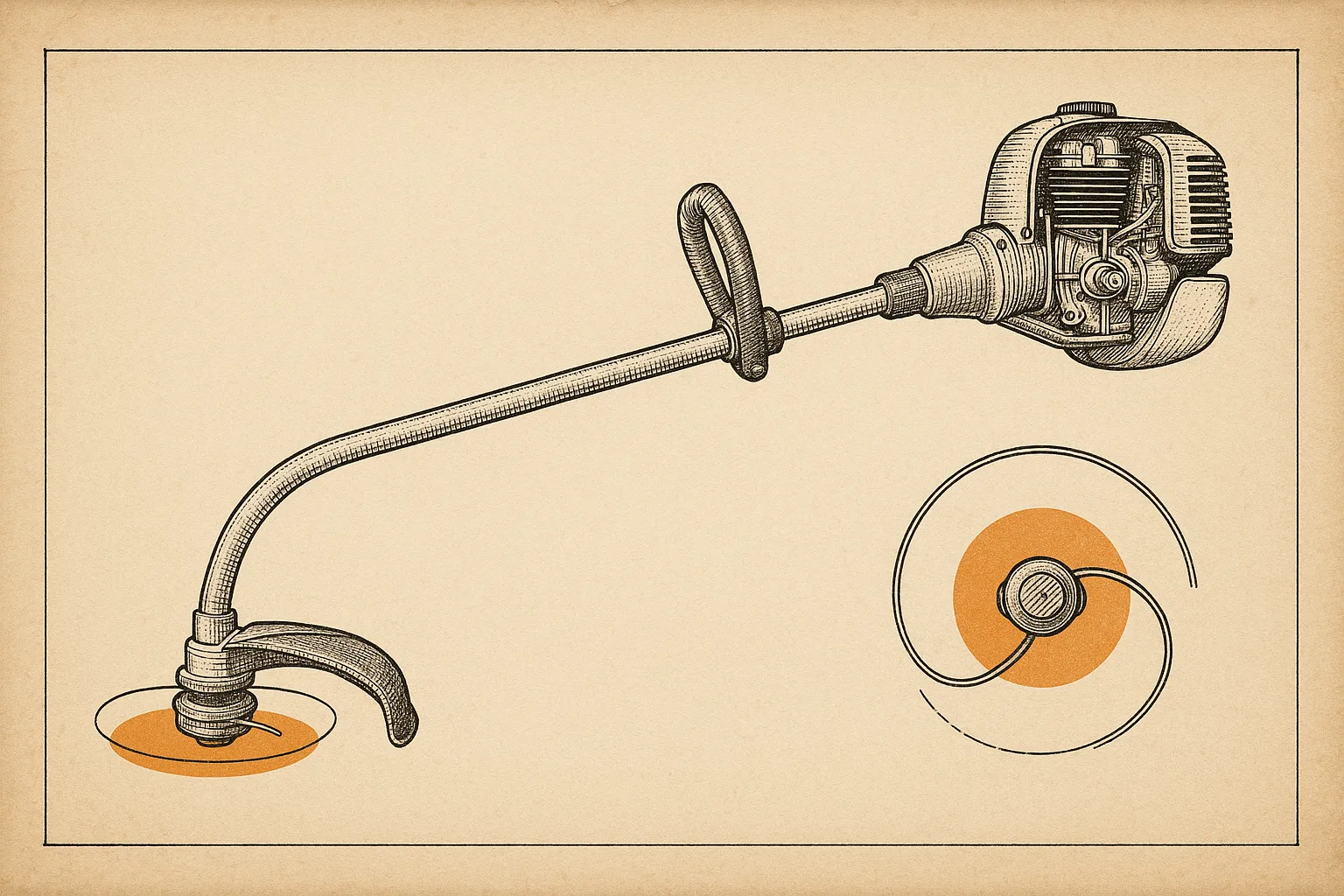
The fence line has quit being grass. What was lawn in June is woody stalk by August — ragweed gone to cane, blackberry testing the wire, saplings starting where the mower can't reach. The machine that skims neatly around the mailbox post is not automatically the machine that clears that, and the difference is printed on the package if you know which numbers to read.
Call it a weed eater, a weed whacker, a strimmer or a string trimmer — it is the same tool, and this guide uses string trimmer. One note before the audit starts: nobody here ran these machines. Per our method, every figure below traces to a manufacturer or industry spec, a binding safety standard, or an independent test run by someone we name and link. The bracketed markers key to the sources ledger at the foot of the page.
The decision#
Two forks decide this purchase, and neither is a brand name. Fork one: what are you actually cutting? Trimmer line comes in duty classes by diameter — roughly 0.080 in. for maintained grass, 0.095 in. for standard mixed growth, 0.105 in. and up for heavy, woody material — and thicker line demands a more powerful head to keep it at cutting speed [1][2]. Fork two: where does the energy come from? Battery, gas, or a cord — and if you are buying new in California, regulation has leaned hard on the answer: gas trimmer engines of Model Year 2024 or later must be zero-emission to be produced for sale there, so the new-gas shelf is limited to leftover pre-2024 stock selling through [3].
Resolved by situation — there is no "best":
- First house, modest yard, kept grass. A battery trimmer running light 0.080-class line covers the job the injury and test record describes for most homeowners. Downside: you are marrying a battery platform — the pack, not the tool, is where the money goes, and runtime per charge is fixed until you buy a second pack.
- Acreage, fence lines, real brush. This is 0.095–0.105+ line territory, which means a head with the power to hold speed under that load [1] — the strongest battery units or a gas machine. Downside for gas: fuel, engine upkeep, and in California a new-gas market reduced to leftover pre-2024 inventory [3]. Downside for battery: long sessions are hostage to how many packs you own.
- Small contractor or crew. All-day duty is exactly where the public evidence thins out — the head-to-head tests below are consumer-grade and battery-heavy. Consumer Reports' owner-reliability survey, drawn from 53,283 trimmers, is the closest thing to fleet data in public view [4]. Downside either way: you are extrapolating past the tests.
- Renter with a patch of grass. The cheapest corded and small-battery class is thinly covered by the named tests here; that is an evidence gap, not an endorsement either way. Buying into the tested class costs more; buying below it means buying without receipts.
The evidence table#
First, the line classes, because they are the spec the rest of the purchase hangs on. These tiers are consistent across Pro Tool Reviews' battery-trimmer buying guide and Titan's line-size guide [1][2]:
| Line diameter | Duty class | Meant for | Source |
|---|---|---|---|
| 0.080 in. | Light | Maintained grass, routine edging | [1] [2] |
| 0.095 in. | Standard | Mixed growth, heavier weeds | [1] [2] |
| 0.105 in. + | Heavy | Woody brush, clearing work | [1] [2] |
Second, who has actually tested these machines, and how. This is the independent record this guide leans on, named per our rule:
| Tester | Method | Scale | Source |
|---|---|---|---|
| Consumer Reports | Times each model clearing a defined path through yard weeds, high grass, and dense brush; also tests edging and ease of use | More than 80 models rated; reliability and owner satisfaction from a member survey of 53,283 trimmers bought 2018–2025 | [4] |
| Pro Tool Reviews | Instrumented head-to-head: timed cutting through three layers of Vigoro reed fencing across an 8-ft section, quickest of two runs per model | Battery string-trimmer shootout, repeated across model years | [5] |
| Project Farm (Todd Osgood) | Buys every unit tested with his own and Patreon funds and declines all sponsorships; publishes measured side-by-side brand comparisons | YouTube channel since 2017; ~470 videos, 830M+ views, ~3.5M subscribers; includes a battery string-trimmer comparison | [6] [7] |
The reasoning: swath, line, and stored energy#
Spec A trimmer's cutting swath is the rated diameter of the circle its line sweeps — roughly 12 to 18 in. across the consumer battery classes [1]. Wider swath means fewer passes down the fence line, but swath is not free: Pro Tool Reviews' buying guide keys swath directly to motor power — the larger the cutting swath, the more powerful the motor it takes to drive it [1]. A wide swath on a weak power head is the mismatch that rule exists to prevent, and it surfaces as a trimmer that bogs in exactly the growth where you wanted the width.
The same trade shows up in the line spool. Thicker line clears woodier material, but it is heavier and drags harder, so it takes a more powerful head to keep it at cutting speed [1][2]. That is why the line class row in the table above is really a power-class row in disguise: a bargain trimmer wearing 0.105-inch line is a spec-sheet contradiction. Match the line class to the growth first, then buy the head that can spin it.
RULE THICKER LINE ⇒ MORE POWERFUL HEAD Source: Pro Tool Reviews buying guide; Titan line-size guide [1][2]
Inference On the battery side, the arithmetic worth doing before checkout is energy, not volts. A pack's stored energy is voltage times amp-hours: an 18 V, 5.0 Ah pack holds 18 × 5.0 = 90 watt-hours, while a 40 V, 2.5 Ah pack holds 40 × 2.5 = 100 — nearly the same stored energy despite the much bigger number on the front of the box. Voltage headlines sell tools; watt-hours cut grass. Comparing two cordless trimmers by pack watt-hours — both figures are on the spec sheet — is a fairer runtime proxy than comparing volts, and it is arithmetic you can check on the page.
Gas's remaining advantage is duty, not power class: a tank refills in a minute at the fence line, while a battery's runtime per charge is fixed and more runtime means owning more packs. Which side of that trade you live on is a function of how far your longest session runs from a wall outlet — nobody's spec sheet can answer that for you.
Standard Regulation has meanwhile put a thumb on the scale. Under the California Air Resources Board's Small Off-Road Engine (SORE) rule, most new spark-ignition engines of 25 horsepower or less — the class that includes gas string trimmers, mowers and leaf blowers — must meet zero-emission standards starting with Model Year 2024 to be produced for sale in California; the rule binds manufacturers, not owners [3]. Owning and running existing gas equipment remains legal there, and leftover pre-2024 gas stock can still be sold off the shelf [3], but the retail future in the largest state market is battery, and manufacturers' catalogs have been filling accordingly.
The safety file#
Standard Gas-powered hand-held trimmers and brushcutters are built to ANSI/OPEI B175.3 ("Internal Combustion Engine-Powered Hand-held Grass Trimmers and Brushcutters — Safety and Environmental Requirements," current edition 2019), the product safety standard listed by the Outdoor Power Equipment Institute [8]. Battery and electric units are certified under the harmonized UL/IEC 62841 series covering motor-operated hand-held and lawn-and-garden machinery [9]. A unit sold without marks to those standards is outside the safety system this section describes.
Tested The injury record is not small. A peer-reviewed study in the Journal of Safety Research (2012), using the CPSC's National Electronic Injury Surveillance System, estimated 81,907 lawn-trimmer injuries treated in US emergency departments from 2000 through 2009 — about 8,200 a year — with the injury rate rising from 2.13 to 3.11 per 100,000 people over the decade [10]. The most commonly injured body part in that study was the head — and specifically the eye [10]. For scale, the CPSC's long-standing figure — it dates to the 1990s — for lawn and garden tools overall is roughly 400,000 emergency-room visits a year [11].
MOST-INJURED BODY PART: THE HEAD — MOST OFTEN THE EYE Source: Journal of Safety Research (2012), NEISS data [10]
Standard The countermeasure for the eye is a solved problem. OSHA's eye-protection rule, 29 CFR 1910.133, requires protection where flying particles are a hazard and incorporates the ANSI/ISEA Z87.1 design standard for the eyewear itself [12]. That is a workplace rule, and a trimmer throwing debris at your face on a Saturday does not know the difference — Z87.1-marked glasses are the floor. They are printed with "Z87" on the frame or lens, and they cost less than a spool of good line.
What breaks#
The published record documents three failure modes worth buying against:
- The cut bogs. A wide swath or thick line on a power head that cannot hold speed under load — the mismatch Pro Tool Reviews' guide keys its swath and line-size rules against — shows up as a trimmer that stalls in exactly the heavy growth it was bought for [1].
- The line class is wrong. Light line in woody brush wears and snaps continuously; heavy line in a light head drags it below cutting speed. The tier table above is the fix, and it is on the line package [1][2].
- The operator, not the machine. The injury ledger above says the most common casualty of a string trimmer is a person — struck most often in the head, and most often in the eye [10]. The eyewear line item belongs in the purchase price.
What the evidence doesn't cover#
Owning the gaps is part of the method, so here they are:
- Durability has no public lab test. Consumer Reports' reliability scores are drawn from owner surveys — a large sample, but self-reported use, not instrumented teardown [4]. Nobody publishes cross-brand wear-out testing of trimmers.
- The head-to-heads are battery-heavy and consumer-grade. Corded electrics and commercial gas units are thin in the named shootouts [5]; verdicts about those classes here are extrapolation, and we have kept them conditional for that reason.
- Bump-feed head reliability. Our source hunt turned up no published cross-brand test of line-feed mechanisms, which is the component owners complain about most in forums — anecdote, not evidence, so it carries no weight above.
- Model-level results churn. Trimmer model generations turn over fast, so this guide cites the testers and their methods rather than quoting a model-year leaderboard that will be stale by the time you read it. Before buying a specific unit, check the current-year results at the sources below [4][5][6].
Sources ledger#
- Pro Tool Reviews, "Battery-Powered String Trimmer Buying Guide" — line-diameter classes, swath-vs-power guidance.
- Titan, "String Trimmer Line Size Guide" — line-diameter duty tiers.
- California Air Resources Board, news release: updated regulations requiring most new small off-road engines to be zero-emission by 2024 — Model Year 2024 start, rule applies to manufacturers, existing equipment and pre-2024 shelf stock unaffected; SORE definition (spark-ignition engines at or below 19 kW / 25 hp) per the CARB SORE program page.
- Consumer Reports, string trimmer buying guide (more than 80 models rated; timed path-clearing and edging protocol) and "Best String Trimmers of the Year" (member reliability survey of 53,283 trimmers purchased 2018–2025).
- Pro Tool Reviews, "Best Battery-Powered String Trimmer Shootout" — cutting-speed rig: three layers of Vigoro reed fencing, 8-ft section, quickest of two runs.
- Project Farm, Patreon about page — self-funded purchases, declines all sponsorships; his battery string-trimmer head-to-head: "Best String Trimmer (Battery Powered)?".
- CreatorSpin, Project Farm channel profile — channel since January 2017, ~470 videos, 830M+ views, ~3.5M subscribers.
- Outdoor Power Equipment Institute, product safety standards listing — ANSI/OPEI B175.3-2019, hand-held grass trimmers and brushcutters.
- UL Solutions, on the UL/IEC 62841 standard series — electric motor-operated hand-held tools and lawn-and-garden machinery.
- Journal of Safety Research (2012), lawn-trimmer injury study using CPSC NEISS data, 2000–2009 — PubMed 22710000 / ScienceDirect — 81,907 estimated ER-treated injuries, rate 2.13→3.11 per 100,000, head (specifically the eye) most injured.
- US Consumer Product Safety Commission, "Lawn and Garden Safety Tips" news release (1996) (archived copy) — about 400,000 people treated in hospital ERs per year for injuries from lawn and garden tools.
- OSHA, 29 CFR 1910.133, Eye and face protection — requirement and incorporation of ANSI/ISEA Z87.1.
Change notes#
Cite this page: Precious Handyman, "How to Choose a String Trimmer: The Evidence, Audited," updated 2026-08-05, https://precioushandyman.com/best-weed-eater/