Buying guide · Home systems
Sump Pumps: The Head Arithmetic Nobody Prints on the Box
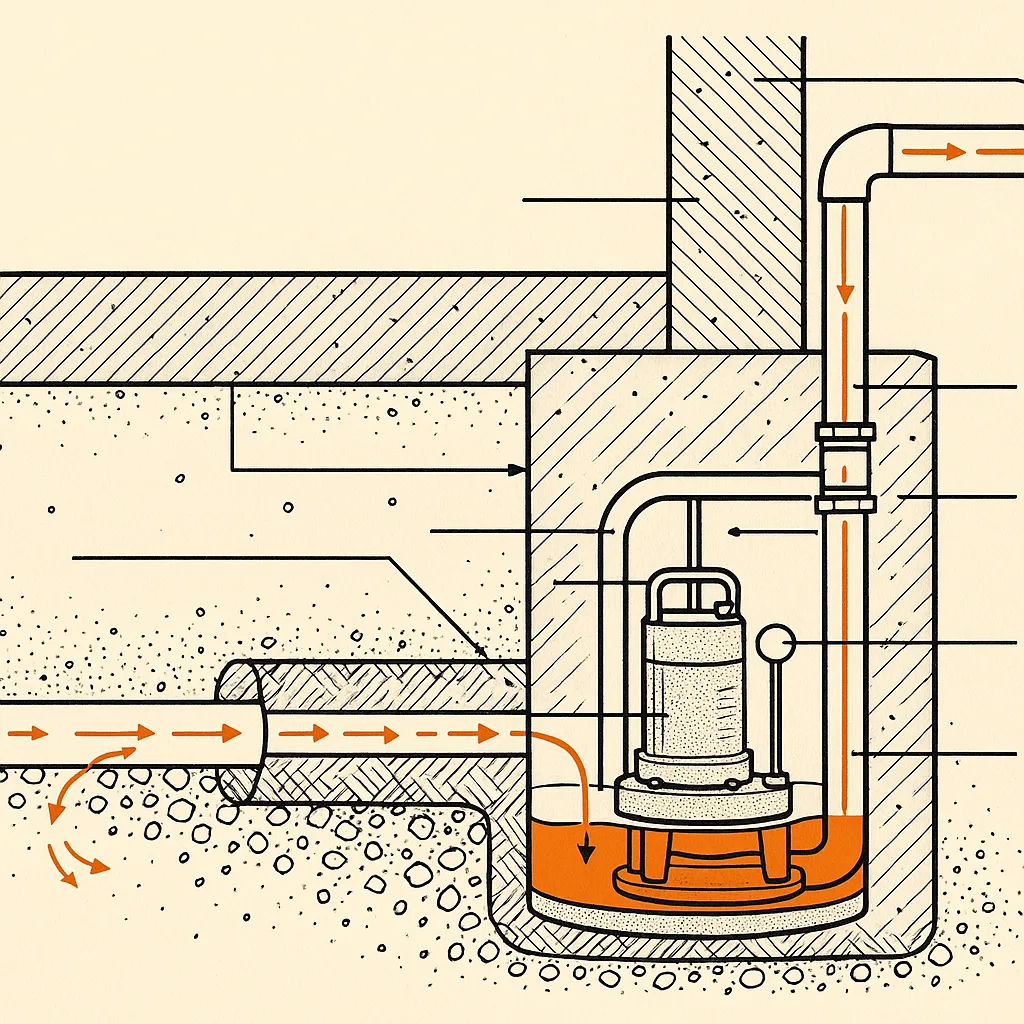
We don't run a test lab, and this guide will not pretend we flooded a basement to find out. What follows is an audit of the published record on residential sump pumps: what the model plumbing code actually requires of the sump, what the industry rating standard means when a manufacturer prints a flow figure, two manufacturers' own specification sheets read line by line, and our arithmetic from those numbers with the working shown. Every number carries a marker keyed to the Sources Ledger at the bottom.
The job: three inches of water and a working outlet #
It is the third day of rain. The water table has come up under the slab, the drain tile around the footing is doing exactly what it was built to do, and every gallon of it is arriving in a plastic barrel sunk into the corner of your basement floor. A pump sits on the bottom of that barrel. Whether the furnace, the water heater and the boxes on the floor survive the night is a question about one motor, one float, one check valve, and one circuit.
Almost every buying decision here gets made on a single number printed large on the carton — gallons per hour, or horsepower. Both numbers are real. Neither one is the number that decides whether your basement stays dry, and the documents say so plainly.
The fork that decides it #
How far up, and how far over, does the water have to go?
Not "how big is the basement" and not "how much rain do we get." A submersible pump's published flow is a curve, not a number: Liberty Pumps' own specification for its 1/3 hp 250-Series states a maximum flow of "44 GPM @ 5 feet of total dynamic head" and a shut-off head of 23 feet[3]. Five feet is a test-rig height. Your basement is not five feet.
- Short lift, short run (a walk-out or shallow basement, discharge daylighting a few feet away): a 1/3 hp pump is working near the fat part of its curve and the horsepower upgrade buys little. Downside: nothing much — this is the case where the cheap answer is also the right one.
- Tall lift, long run (a full basement, the discharge climbing eight or ten feet and then running out to the property line): you are working near the thin end of the curve, where the same pump moves far less water. Step up in head capability, not in marketing horsepower. Downside: a bigger pump in an undersized pit short-cycles, and cycling is what kills switches.
By reader:
- First-house DIYer: before you shop, measure two things — floor of the pit to the point the discharge leaves the house, and the horizontal run after that. Those two numbers pick the pump. The arithmetic is below.
- Renter: this is the landlord's equipment and the landlord's circuit. What is yours is what sits on the floor, and the federal flood-insurance fact sheet is blunt about how little of that is covered — see the money file.
- Small contractor: the code language you will be held to is short and specific — pit size, an accessible full-flow check valve, discharge pipe not smaller than the pump tapping[1]. It is quoted in full in the code file.
- Homesteader on a well and a generator: the pump is a load you have already sized elsewhere — a sump pump appears in the generator arithmetic for exactly this reason. What matters here is that its failure mode is correlated with the storm that causes the flooding. See the backup file.
- Anyone with a finished basement: the insurance asymmetry in the money file is the reason a second pump is a rational purchase and a bigger first pump usually is not.
What a sump pump is, in the documents #
The trade association that runs the certification program defines the category narrowly. The Sump and Sewage Pump Manufacturers Association's Recommended Standards calls a sump pump "a pump powered by an electric motor for the removal of clear and/or ground water drainage from a sump, pit or low point in a residential, commercial or industrial property," and notes that "solids-handling sizes of Sump Pumps are typically less than ½" in diameter"[2]. Effluent pumps (½" to 1") and sewage pumps (1" to 2") are separate categories in the same document[2]. This matters at the shelf, because the same casting is often sold in more than one of those roles and the price gap looks arbitrary until you read which one you are buying.
Where the water arrives from is also specified. The IRC requires subsoil drains to be "open-jointed, horizontally split or perforated pipe," "not less than 4 inches (102 mm) in diameter," discharging "to a trapped area drain, sump, dry well or approved location above ground"[1]. The pump is the last component in a drainage system, not the system.
The code file: what the sump itself has to be #
Standard Section P3303 of the International Residential Code governs sumps and pumping systems. Four requirements, and the most interesting one is the requirement that isn't there.
SUMP PIT ≥ 18 IN DIA · ≥ 24 IN DEEP · SOLID FLOOR
DISCHARGE PIPING ≥ PUMP TAPPING · ACCESSIBLE FULL-FLOW CHECK VALVE
PUMP CAPACITY "APPROPRIATE TO ANTICIPATED USE" — NO NUMBER GIVEN Source: International Residential Code 2021, Section P3303 [1]
| Requirement | Code text | Grade | Source |
|---|---|---|---|
| Pit size | "not less than 18 inches (457 mm) in diameter and 24 inches (610 mm) deep, unless otherwise approved" | STANDARD | IRC P3303.1.2 [1] |
| Pit construction | "tile, steel, plastic, cast iron, concrete or other approved material, with a removable cover adequate to support anticipated loads"; "the sump floor shall be solid and provide permanent support for the pump" | STANDARD | IRC P3303.1.2 [1] |
| Pit location | "accessible and located so that all drainage flows into the sump by gravity" | STANDARD | IRC P3303.1.2 [1] |
| Check valve | "Discharge piping shall include an accessible full-flow check valve" | STANDARD | IRC P3303.1.4 [1] |
| Discharge pipe size | "Pipe and fittings shall be the same size as, or larger than, the pump discharge tapping" | STANDARD | IRC P3303.1.4 [1] |
| Electrical | "Electrical outlets shall meet the requirements of Chapters 34 through 43" | STANDARD | IRC P3303.1.3 [1] |
| Subsoil drain | perforated or open-jointed pipe, "not less than 4 inches (102 mm) in diameter"; backwater valve where the building is subject to backwater | STANDARD | IRC P3302.1 [1] |
| Pump capacity | "of a capacity and head appropriate to anticipated use requirements" | STANDARD | IRC P3303.1.1 [1] |
That last line is the whole guide in one sentence. The code specifies the hole in your floor to the inch and the check valve by name, and then declines to specify the pump at all — because the right capacity depends on how much water arrives and how far it has to be pushed, and no code can know either. The number the code refuses to give you is the number the carton gives you with total confidence.
Two practical consequences follow directly from the text. Inference First, "the sump floor shall be solid and provide permanent support for the pump"[1] rules out the common improvisation of a pump resting on loose gravel — the pump settles, the intake screen sits in silt, and the impeller eats what the screen was meant to keep out. Second, "accessible" appears twice — once for the sump and once for the check valve[1]. A check valve buried behind finished wall is code-noncompliant and, more to the point, is the part most likely to need attention.
What a printed rating actually promises #
Standard Pumps carrying the "SSPMA-Certified" seal are "tested and rated in accordance with SSPMA Standards"[2], and the standard spells out the test bench in detail: clear water "between 50° F (10° C) and 80° F (27° C)," the liquid around the pump "relatively quiet and not filled with entrained air whirls," gauges accurate to ±2%, discharge gauge at least five pipe diameters from the pump, and the pump tested at nameplate voltage with amps "not greater than +10% of rated nameplate full load amps"[2]. It also recommends that "total head be listed in increments of 5 feet starting at 5 feet"[2], which is why published curves start where they do.
Two clauses in that document are worth committing to memory before comparing any two pumps.
Standard The tolerance. "The performance of any new production pump shall not be less than 90 percent of rated flow rate at stated total heads"[2]. A certified pump delivering nine tenths of its printed number is conforming, not defective. Any comparison between two pumps whose published figures are within about ten percent of each other is comparing noise.
Standard The field-test disclaimer. "The field test will not be used as indication of conformance to rating unless test conditions conform to" the rating performance test[2] — that is, the bench conditions above. Whatever your pump does in your pit is not a measurement of whether it meets its rating, and the standard says so on its own initiative.
The head arithmetic, shown #
Two specification sheets from one manufacturer, read side by side, do most of the work here. Both are that manufacturer's own engineering documents, and both carry SSPMA and cCSAus certification marks on the same page[3][4].
| Spec line | 250-Series, 1/3 hp | 280-Series, 1/2 hp | Grade | Source |
|---|---|---|---|---|
| Rated horsepower | 1/3 hp | 1/2 hp | SPEC | Liberty [3][4] |
| Motor speed | 3450 RPM | 3450 RPM | SPEC | Liberty [3][4] |
| Maximum flow | 44 GPM @ 5 ft TDH | 62 GPM @ 5 ft TDH | SPEC | Liberty [3][4] |
| Shut-off head | 23 ft | 37 ft | SPEC | Liberty [3][4] |
| Solids handling | 1/2 in. | 3/4 in. | SPEC | Liberty [3][4] |
| Discharge | 1-1/2 in. | 1-1/2 in. | SPEC | Liberty [3][4] |
| Full load amps, 115 V | 5.2 A | 8.0 A | SPEC | Liberty [3][4] |
| Locked rotor amps, 115 V | 8 A | 23 A | SPEC | Liberty [3][4] |
| Thermal overload trip | 105 °C / 221 °F | 105 °C / 221 °F | SPEC | Liberty [3][4] |
| Max liquid temp, continuous | 40 °C / 104 °F | — | SPEC | Liberty [3] |
| Housing / volute | Class 25 cast iron | Class 25 cast iron | SPEC | Liberty [3][4] |
| Weight | 23 lb | 30 lb | SPEC | Liberty [3][4] |
| Certifications | SSPMA, cCSAus | SSPMA, cCSAus | SPEC | Liberty [3][4] |
Inference Now the arithmetic, using only the four published figures in the flow and head rows. A pump curve runs from its maximum flow at low head down to zero flow at its shut-off head. Take the two published endpoints for each pump and draw the straight line between them. Real pump curves are not straight, so the intermediate figures below are approximations and are graded as such — but a straight line between two published endpoints is the only interpolation you can do from published numbers alone, and it is enough to show the shape of the problem. For the 1/3 hp: 44 GPM at 5 ft, 0 GPM at 23 ft[3], so roughly 44 × (23 − H) ÷ 18 at head H. For the 1/2 hp: 62 GPM at 5 ft, 0 GPM at 37 ft[4], so roughly 62 × (37 − H) ÷ 32.
| Total dynamic head | 1/3 hp, approx. | 1/2 hp, approx. | Grade |
|---|---|---|---|
| 5 ft (the published figure) | 44 GPM | 62 GPM | SPEC |
| 10 ft | ~32 GPM | ~52 GPM | INFERENCE |
| 15 ft | ~20 GPM | ~43 GPM | INFERENCE |
| 20 ft | ~7 GPM | ~33 GPM | INFERENCE |
| 23 ft | 0 GPM (shut-off) | ~27 GPM | SPEC / INFERENCE |
Read the first column again. The pump whose box says 44 GPM is a roughly 20 GPM pump at fifteen feet of total head — under half its headline — and it stops entirely at twenty-three. Fifteen feet is not exotic: a pit floor two feet below the slab, a rim joist eight feet above that, a foot or two of rise outside, plus everything the elbows, the check valve and the horizontal run add on top of the vertical lift. That last part is why the figure is called total dynamic head rather than height: friction in the pipe counts, and this guide does not have a sourced number for it (see the gaps box).
Inference The horsepower comparison falls out of the same table, and it is not the one the price tag implies. Fifty percent more rated horsepower buys about 41% more flow at the published five-foot point (44 → 62 GPM) but about 61% more shut-off head (23 → 37 ft)[3][4]. At five feet of head the upgrade is modest. At twenty feet it is the difference between about 7 GPM and about 33 GPM — a pump that is barely keeping up and a pump that is working. The bigger pump is not a "more water" purchase; it is a "more lift" purchase, and if your lift is short you are paying for capability you will never reach.
One more line in that table deserves its own sentence. Inference Both pumps discharge through 1-1/2 inch tappings[3][4], and the code says the pipe "shall be the same size as, or larger than, the pump discharge tapping"[1]. A pump plumbed into 1-1/4 inch pipe because that is what was already in the wall is both a code violation and a self-inflicted head penalty on a curve that had no margin to spare.
Inference And one line that never appears in a sales comparison: locked rotor current. The 1/3 hp draws 8 A locked rotor at 115 V; the 1/2 hp draws 23 A[3][4]. Running current only rises from 5.2 to 8.0 A[3][4], so the upgrade looks harmless on a circuit-load worksheet, while the inrush at every start nearly triples. On a shared basement circuit that also carries a freezer or a dehumidifier, the upgrade is an electrical decision as well as a hydraulic one, and the code sends you to the electrical chapters to settle it[1].
The backup file: the failure is correlated with the flood #
A sump pump's job description contains a structural problem: the weather that makes it necessary is the weather that takes down the grid. A backup is not a luxury tier, it is the answer to the single most likely failure.
The battery-backup approach in wide residential use is an inverter that sits between the wall outlet and the pump. Liberty Pumps' installation manual for its LNV75 describes the behavior precisely: it "converts the energy stored in the battery to AC power to operate the pump" at the moment of a power failure, and this "continues until the issue with the AC power is restored or as long as the charge in the battery lasts"[5]. Note what that sentence does not contain: a runtime.
The manual is specific about the battery, and the specifics are the buying decision:
- A "12-volt marine-type deep cycle battery recommended (Group 27 or Group 31 AGM or Wet Cell compatible)"[5].
- "A Group 27 battery will provide the same performance as a Group 31 battery, but for a shorter length of time."[5] Capacity buys duration, not flow.
- "A full recharge will take 26 hours or 60 hours"[5] depending on the battery. Inference That figure is the one nobody plans around: a second storm two days behind the first arrives before the battery is back.
- "Never charge lithium ion batteries with the Battery Backup"[5] — the charger is built for lead chemistry, and the obvious modern substitution is specifically prohibited by the manufacturer.
- Install "the battery box in a dry location that is protected from flooding," and not directly on a concrete floor[5]. A backup system underwater is not a backup system.
- The unit is fused — a 15 A main fuse (F2) whose failure silently removes 120 VAC from the output receptacle[5]. It is a part that fails closed-looking and open-acting.
Standard There is a second class of backup — a dedicated 12-volt DC pump rather than an inverter — and the SSPMA standard covers those separately. Its DC section requires that "all 12V pumps shall have all testing performed at 12.1 +/- 0.1 V," with the specified voltage "maintained for the duration of the test," and that "a fuse must be used to protect the motor against the possibility of overload"[2]. Inference Read that voltage clause carefully before trusting a DC pump's gallons-per-hour figure: 12.1 V is a healthy, essentially full lead-acid battery. The rating is what the pump does at hour zero of the outage. Nothing in the published rating describes hour six, when the battery has sagged and the pump is slower — and the standard does not claim it does.
The money file: your pump is insured, your things are not #
Standard FEMA's fact sheet on the National Flood Insurance Program is unusually direct about basements, and it inverts most people's assumption. Under the Standard Flood Insurance Policy, covered building items in a basement explicitly include "sump pumps, heat pumps, and well water tanks and pumps," along with furnaces, water heaters, central air conditioners, electrical outlets and switches, and unfinished, un-taped drywall[6].
What is excluded is the part that hurts. FEMA lists among excluded items "personal property (such as couches, computers, or televisions)" and "basement improvements (such as finished flooring, finished walls, bathroom fixtures, and other built-ins)"[6]. The fact sheet is blunt about stored belongings: "If covered items are stored in a basement, meaning they are not connected to a power source, they are not covered."[6] Generators are named as excluded too[6]. FEMA also defines a basement broadly — "any area of a building with a floor that is below ground level on all sides" — and warns that sunken rooms, crawlspaces and split-level lower floors "may still be considered basements"[6].
Inference That asymmetry is the honest economic case for redundancy. The equipment that fails is the cheap thing, and it is the covered thing. The finished floor, the drywall you taped, and everything sitting on that floor are the expensive things, and they are the uncovered things. Spending the upgrade budget on a second pump and a backup power path protects what the policy will not — which is a better argument for redundancy than any horsepower comparison.
One practical note from the same document[6]: FEMA advises documenting "the manufacturer, model, and serial number as well as capacity" of basement equipment before a flood, because "the NFIP requires that the adjuster provide this information during the claims process." Photograph the data plate on the pump the day it goes in.
What breaks #
- The power, at exactly the wrong moment. The correlated failure above. Everything in the backup file exists because of it.
- The check valve. The code requires an "accessible full-flow check valve"[1] for a reason: without one, everything in the vertical discharge falls back into the pit at every shut-off and gets pumped again. A failed valve therefore does not announce itself as a flood; it announces itself as a pump that cycles more often than it used to and wears out early. "Accessible" is the word to insist on at installation.
- The motor, thermally. The 250-Series carries a thermal overload that trips at 105 °C / 221 °F and a continuous-duty maximum liquid temperature of 40 °C / 104 °F[3]. Inference A pump run dry, or run against a blocked discharge, is a pump making heat with no water to carry it away. The protection is a trip, and a tripped pump is an off pump.
- The pit, silting up. The code's "solid" sump floor requirement[1] is the defense; a 1/2-inch solids-handling rating[3] is the margin, and it is not large. Grit that a sump pump can pass is still grit that wears the impeller.
- Comparison shopping itself. The SSPMA 90% production tolerance[2] means two pumps whose published flows differ by less than about ten percent are, on the evidence, the same pump. Choosing between them on that gap is choosing on nothing.
What the evidence doesn't cover #
- No independent cross-brand test. As with air ratchets, we found no published instrumented shootout of residential sump pumps with a stated method — no measured flow-against-head comparison across brands we could cite. Every performance number in this guide comes from manufacturers' own documents and from the rating standard those documents claim to follow.
- Friction loss is not quantified here. Total dynamic head includes pipe friction, elbows and the check valve, and we did not find a manufacturer- or standards-published friction figure for residential sump discharge that we were willing to print. Our head table therefore describes total dynamic head as a variable and declines to convert your basement's dimensions into it. A real installation's head is higher than its vertical lift by an amount this guide cannot source.
- The curve between the endpoints is interpolated. The straight line drawn in the head arithmetic connects two published points. Real pump curves are not straight. The direction of the ranking (bigger pump gains more at high head than at low head) is robust; the individual intermediate GPM figures are approximations and are labeled INFERENCE for that reason.
- Nothing here sizes your inflow. How many gallons per minute your drain tile actually delivers in a storm is a property of your soil, your water table and your roof drainage. The IRC declines to specify pump capacity for exactly this reason[1], and so do we.
- Backup runtime is unpublished. The manufacturer's own description of backup duration is "as long as the charge in the battery lasts"[5]. We found no published runtime table tying a battery group size to hours of pumping at a stated head, so this guide states none.
- Local amendments. The code text quoted here is the International Residential Code as published. Your jurisdiction may amend it, and "unless otherwise approved" appears in the pit-size clause itself[1]. The inspector's copy governs, not ours.
Sources Ledger #
- International Code Council, International Residential Code, 2021 edition, Chapter 33 (Storm Drainage) — Section P3302 (Subsoil Drains) and Section P3303 (Sumps and Pumping Systems), including P3303.1.1 pump capacity and head, P3303.1.2 sump pit, and P3303.1.4 discharge piping and check valve. Retrieved 2026-08-08. up.codes
- Sump and Sewage Pump Manufacturers Association, Recommended Standards for Sump, Effluent and Sewage Pumps, 2019. Part II definitions (sump, effluent and sewage pump categories and solids sizes); Part III testing and rating (test types, total head, gauge accuracy, test water temperature, electrical, the 5-foot rating increments, and the 90 percent production tolerance); Part V DC design (12.1 V test voltage, fusing). sspma.org (PDF)
- Liberty Pumps, Pump Specification: 250-Series, 1/3 hp Sump/Effluent Pumps, document 250_P1–P7, revision 04/2025. Operating conditions (3450 RPM, 23 ft shut-off head, 44 GPM at 5 ft total dynamic head, 1/2 in. solids), electrical data table (115 V full load 5.2 A, locked rotor 8 A, thermal overload 105 °C), technical data (Class 25 cast iron, max continuous liquid temperature 40 °C, 23 lb, SSPMA and cCSAus certifications). libertypumps.com (PDF)
- Liberty Pumps, Pump Specification: 280-Series, 1/2 hp Sump/Effluent Pumps, revision 04/2025. Operating conditions (3450 RPM, 37 ft shut-off head, 62 GPM at 5 ft total dynamic head, 3/4 in. solids), technical data (30 lb, SSPMA and cCSAus certifications). libertypumps.com (PDF)
- Liberty Pumps, Installation Manual — Sump and Sewage Pump Battery Backup, Model LNV75, document 1298000B, 2025. Backup operation description, battery type and group size guidance, recharge times, lithium-ion prohibition, battery-box siting, and the F2 15 A main fuse. libertypumps.com (PDF)
- FEMA, What Does Flood Insurance Cover in a Basement?, National Flood Insurance Program fact sheet, January 2022. Basement classification, covered building items (including sump pumps), the stored-contents exclusion, and the pre-flood equipment documentation requirement. agents.floodsmart.gov (PDF)
Cite this page: "Sump Pumps: The Head Arithmetic Nobody Prints on the Box," Precious Handyman, updated 2026-08-08, https://precioushandyman.com/best-sump-pump/